Saturday, July 22, 2017

Review - Dunkirk (2017)


A masterful third-act
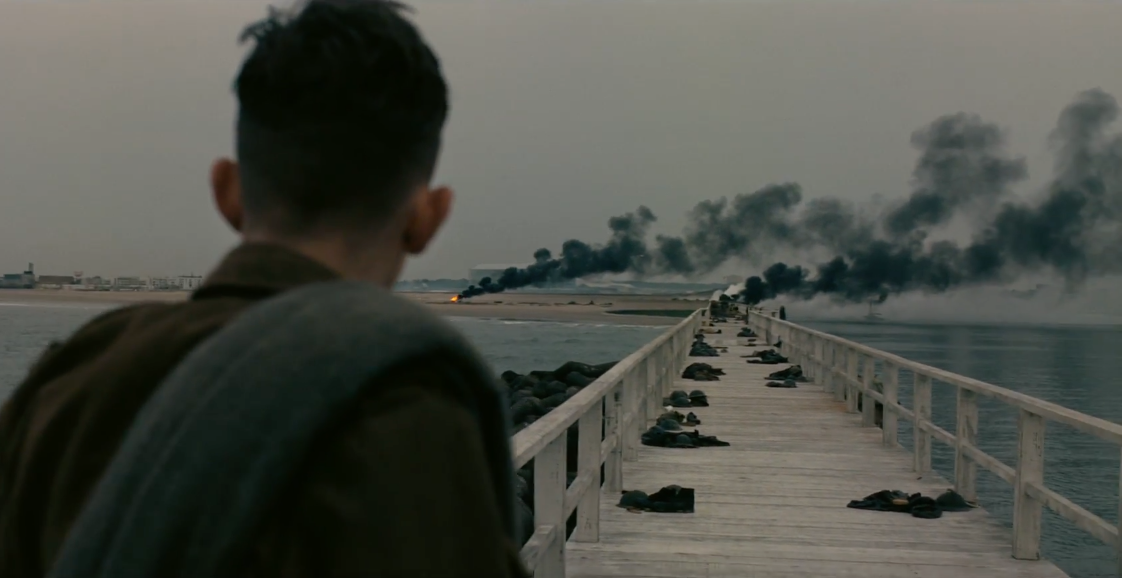
Dunkirk lacks any drama, which is probably the biggest flaw of the film which is otherwise flawless.
Of all the war movies I have seen, Saving Private Ryan is probably the best - albeit not without minor quibbles. That film was released way back in 1998 and yet watching it today, it remains an emotional and visceral experience. 19 years later, our modern cinematic virtuoso, Christopher Nolan has brought Dunkirk, which has been hailed as the best war movie ever made by multiple critics. Agreed, when you know it is Nolan, you don't need anything else to validate. Standing at a spectacular 94 on Metacritic, it is probably the Nolan's most unanimously loved film. But is this film as good as it is being proclaimed?

Evacuation of Dunkirk took place early on during World War II. The allied troops were completely surrounded by German army on the French land and they were pushed deep into the shores of English Channel. Around 300,000 soldiers were stranded on the beaches of Dunkirk, waiting to be torn apart by enemy air raids or for a miracle that might rescue them. What Churchill called 'a colossal military disaster', Dunkirk was certainly an important chapter for World War II. We all know the outcome, most of the soldiers were indeed saved and it certainly was an early blow to the Axis. Nolan obviously assumes that you know your history and hence he wastes no time to explain any background. There are some title cards which do impart some information, but if you are going to watch Dunkirk, it is better that you read a paragraph or two about it on Wikipedia. 


The opening of Dunkirk is sheer cinematic excellence - we follow a British private Tommy (Fionn Whitehead) as he escapes the titular deserted town from the Germans. As he reaches the shore, the camera sweeps through the vast stretch of sandy beach and the blue ocean, and along with thousands of soldiers scattered like ants. Just then, a roaring sound of subsonic German planes renders all of the men crawling down on the land, covering their ears with their hands. Among many of the film's iconic shots, we see bombs dropping off, one by one, approaching Tommy in a serial order. The shot ends with Tommy surviving the "bomb-line", but not without a flurry of sand deluging him.

Nolan, having written the script as well, divides the film into three temporal perspectives - the land, one week; the sea, one day; the air, one hour. The land covers the journey of Tommy and how he survives the constant bombardment and shooting by the enemy while waiting to be rescued; the sea covers a mariner named Mr. Dawson (Mark Rylance), how he sails to Dunkirk to rescue the stranded, along with his son, Peter and a teenage acquaintance, George; and the air covers Farrier (Tom Hardy), a British Royal Air-force pilot, assigned with the task of taking down the German planes. We follow each of these perspectives in a cross-cut fashion and the finale leads to intersection of all these strands in a neat, effective result.

Nolan's forte has always been brilliant use real-life props and sets. Obviously, he has employed digital visual effects, but you do appreciate the fact that they have been avoided as much as possible. In fact, real aircraft have been used for the film. The outcome is a set of multiple dazzling action sequences, which are not just breathtaking to behold, but also fully immersive in their approach. Cinematographer Hoyte van Hoytema conjures one stunning imagery after another - the entire air perspective consists of the best aerial photography ever shot for a film. The sound design also deserves to be mentioned here, and for the first time, Nolan's use of bombastic and deafening sound seems completely justified. 

After so much of praise, is it the case that the film is indeed one of the best war film ever made? The answer is sadly, a no. With all the technical aspects and innovative structure of its storytelling, Dunkirk's major flaw is the lack of an emotional core. Worse, it is actually intentional - Nolan wanted it to function as a third act of any war movie. But this approach backfired. There is no back story for any of these characters and they have been written as a generic placeholders for the military roles. Even with veteran actors like Kenneth Branagh and Mark Rylance, the film fails to deliver any empathic connection. It all plays out like one action sequence after another - even though thrilling and perfect as they are, they cannot act as a substitute for dramatic heft. 

Just like Interstellar, Nolan's over-indulgence has restrained him to achieve what his vision clearly does. Thrilling, soaring and absolutely worth watching on the biggest screen you can get, the film is unfortunately mechanical and emotionally aloof. Only if Dunkirk had its first two acts, it could have been a masterpiece.

3.5/5


Sunday, July 9, 2017

Review - The Circle (2017)

Sharing is caring.

Yeah! Tom Hanks presenting an iPhone launch event!
Do you post stories on Snapchat more than you drink water throughout the day? Do you obsessively put your selfies on Instagram and refresh the app to check likes? Do you prefer to shoot a live video of your vacation instead of actually being in the moment? If your answer to all of these questions is "yes", then The Circle might just prove an eye opener for you. If not, then you are in for a pretty bland cinema with bits and pieces of interesting themes scattered throughout. More often than not, you would rather scroll down your Facebook feed instead of looking up at screen. 

Based on a dystopian novel by Dave Eggers, the film is about a young college graduate Mae (Emma Watson) who lands a job in a Facebook/Google-esque company called The Circle. Headed by a charismatic CEO named Eamon Bailey (Tom Hanks), the social-networking company is like a dream for any employee - vast, green campus with so many things to do that you won't find even in a big city, a hefty paycheck with awesome medical benefits. For obvious reasons, Mae falls for it. So much that she goes transparent - that is to say, she volunteers to put on a small button like camera on herself and broadcast her daily life to every single person linked with The Circle. Yes, it does sound like a Facebook-Live version of Keeping-Up with Kardashians, the only issue being Mae's life is pretty boring as compared to anything Kim does on the show. Really boring.

Even with talented actors like Hanks and Watson, the film sinks - and the blame must be put on the screenwriter. Without bothering to explain the technical hurdles in order to maintain such a gigantic social platform, the film loses it with the absurdity of how most of the people feel that its OK to go live and broadcast every single hour of your life. The film goes to such an extent that it shows people from government supporting this horrible idea - and those few who are skeptical, refrain to protest until the very end. Worst of all, there is hardly any conflict. There is no antagonist and even the protagonist is disappointingly confused and one-note. Watson and Hanks are mostly presenting big ideas in front of a large awe-struck audience, just like an iPhone launch. The film gets redundant to such a limit that you lose any interest in the story. 

The film is labeled as techno-thriller - the techno part is certainly there, but unfortunately there are no thrills. The only one moment near the finale ends up with a conclusion which we don't see happening onscreen. By the last 20 minutes or so, the film appears as if to be redeeming itself with a shift to the right track - exploring the financial exploitation by privacy invasion and a possible global revolt against a scheming tech giant. But it all ends too soon without any proper pay-off. The Circle flirts with some really interesting notions which have been previously dealt by masterpieces like Truman's Show and on a broader political level by V for Vendetta. But it does nothing to flesh out its characters or even provide a substantial commentary on the issue it is tackling. The Circle is indeed a disappointment.

PS. The logo of 'The Circle' company is pretty similar to SBI logo (just rotate it to 45 degrees counter-clockwise)

2.5/5 

Saturday, May 20, 2017

Review - Moonlight (2016)

A little film that could

Even though the film's protagonist is played by three different actors, all them embody his spirit perfectly.

How often do you get to see a film based on a black, poor and gay protagonist winning an Oscar for Best Picture? Certainly not very often. In fact, it took 89 years for the AMPAS to overcome their inherent racism and homophobia - you can even argue that most Oscar-winning black movies were about slavery, or their struggle during civil rights movement. So Moonlight has certainly broken variety of barriers - but is it really as good as it is being proclaimed?

Moonlight depicts life of an African-American boy named Chiron in three chapters - Little, Chiron and Black. These chapters deal with him growing up in poor Miami neighborhood with cocaine epidemic on the rise, constant school bullying and his struggle with his sexuality. On paper, Moonlight appears to be a soul-sibling to Richard Linklater's wonderful Boyhood - but without a main protagonist who has the "privilege" of being white, straight and opulent. In fact, on many levels, the film remarkably deviates from the normal, acceptable narrative of coming-of-age dramas.
Technically, the film is meticulously crafted. Every scene, every moment is well thought. From cinematography to background score, from editing to sound design - each and everything falls well into the place, like a puzzle fitting perfectly into its position.

Barry Jenkins has created a little precious gem - a realistic document of how growing up in a poverty-stricken and hyper-masculine environment may damage vulnerable young children. Moonlight makes a point against homophobia and lamentable position of non-white Americans. However, lack of a concise conclusion dilutes the dramatic impact of its ending. But even with its minor flaws, Moonlight should be celebrated - it is a little film that could.

3.5/5

Monday, January 30, 2017

Review - Manchester by the Sea

The tale of never-ending grief


Manchester by the Sea is a sad, sad film. The protagonist of this film is constantly grieving, never coming to terms with his tragic past. He is stuck, never moving on, even when life literally throws bundle of opportunities towards him for doing so. The film makes this point - if you have messed up real bad in your past, your future won't be a blissful joy. But bigger issue for the film itself is this - will you spend over two hours watching a suffering man wearing a same sad expression and mumbling most of the time?

Clearly enough, the film is not an easy watch. Cassey Affleck stars as Lee Chandler, an ill-fated janitor who has got the custody of his 16-year old nephew after untimely death of his brother. Lee for much of the film (except for some flashbacks) is melancholic, hardly taking interest in any living or non-living thing. Earlier in the film, we see him reacting on the news of his brother's death -  stoic, almost blank albeit with a hint of concern. He sees his brother's dead body, again, with the same old expression on his face. You wonder, what is wrong with this man?

Kenneth Lonergan, also directing this film, has written the script in an intriguing fashion. The film is told with alternate cuts of flashbacks and present proceedings, which creates a sense of mystery, especially regarding Lee's troubled past. It does unfold near the film's half-way, and it is indeed shattering - a mistake, or rather a gigantic blunder which has not only destroyed Lee's own life, but also his family's. 

The present timeline of the film deals with Lee slowly taking the role of his father-less nephew's guardian, even though he feels strongly evasive about it. The demons of his past however, are ever troubling him, even taking a toll on his mental state. Lee hoards an ocean of repressed anger, mostly directed towards his own self, which often manifests via violent outbursts of drunken brawls. The dynamic between Lee and his nephew is particularly interesting, and it is perhaps the only "fun" part of the film where Affleck's coerced guardian tries to understand peculiarities of the teenage boy.

The film is soaked with melancholia. The sky is ever dark and overcast, there is always snow around and not even a single ray of sunshine hits the frozen surface. Cassey Affleck plays his part extremely well, he's subtle and reserved. Even in the scenes where there was some scope of dramatic fireworks, he remains grounded and true to his character's psychological state.

But that also means that there is nothing in this film which bounds the audience to its characters. The overwhelmingly dreary tone and sluggish pace doesn't help either. Worse, there is no narrative arc in this film. Lee's character is at same state in the end as he was in the beginning, there is nothing to take back home. As a dramatic film, Manchester by the Sea fails, but as a character study of depressed soul with a tragic past, you cannot get anything better than this.

3/5

Sunday, January 15, 2017

Review - Arrival (2016)

Story of your life

Amy Adams gives a remarkable performance in Arrival.
It's a tricky task to put Arrival into a certain genre, or to be specific, under "Science-Fiction" category. Yes, there is much science and fiction going on in it, but unlike many others, the film is like a dreamy, melancholic piece - a swan song of sort, which pulls your heartstrings more than exercising your cerebral thinking. It moves you in ways which sci-fi films don't. Thanks to outstanding work by Amy Adams and equally masterful direction by Denis Villeneuve - Arrival defies common genre boundaries by every sense.

Sometime in near future, twelve extra-terrestrial space pods arrive at various locations across the globe. The capsule like enclosures hover some twenty feet over the land and none of the life form which resides within them seem to be coming out or making any contact. "Why they are here?" is the billion dollar question which needs to be answered right away. As media and general public all over the world becomes more anxious and fearful about the nature of these spaceships, military forces start to take precautionary action and teams of scientists are assembled to uncover their truth. 

Louise Banks (Amy Adams) is a linguist professor at a university in Montana. Having worked with military intelligence before, she is recruited by the army for a top secret mission - to communicate with the alien beings and discover their actual motive of arrival at Earth. She is joined by Physicist Ian Donnelly (Jeremy Renner) on the mission, and as tensions rise all over the world, both of them together start a series of sessions. Starting with rudimentary form of communication with chalk and slate, Louise and Ian take baby-steps, one day at a time to learn the alien language.

The alien language is particularly amusing and visually striking. The circular loops of inky-black wisps may refer to a word, sentence or even an entire notion. The aliens themselves are a cross between a giant humanoid and an octopus, albeit with seven legs. Their voice (much credit to the sound design team) is eerily outlandish and yet, not so threatening. As the sessions continue, both Louise and Ian learn about the exotic loop symbols and much of the film's middle portion is devoted to it. By the last thirty minutes however, Eric Heisserer's script takes a mind-boggling twist. I would rather not divulge that twist here, but let's say that it makes this film a worthy companion to recent celebrated works like Interstellar and Gravity. To drop a tiny hint - the film brings up alluring notions about your past memories, your losses, your decisions and how they all ultimately affect your life. 

Beautifully shot and aptly paced, Arrival is technically flawless. The design of creatures and the pod is strikingly original, while the use of Max Richter's On the Nature of Daylight is deeply moving. Adams is subtle and quite understated for much of the film, but her scenes near the end deliver a powerful emotional punch on the audience. The film is literally carried on her shoulders, and much like Sandra Bullock in Gravity, she carries it with strength and robustness.

During the opening voice-over, Adams' character says "I'm not so sure that I believe in beginnings and endings. There are days that define your story beyond life." Like a palindrome, the film has no beginning or an end - it's a sequence of events and memories, and irrespective of which end you traverse it, you would always go through the same emotions and same feelings. With brilliant central performance by Amy Adams, Arrival is unique and surprisingly emotional film. The film's last minutes make a grand statement about life, and combined with the effect of the opening and the last shot, you take home much more than mere science-fiction.

3.5/5

Thursday, December 29, 2016

Review - Nocturnal Animals (2016)


Revenge redefined.

Tom Ford's Nocturnal Animals is a peculiar, yet a beautiful film. It reflects on a heavily overused theme - revenge - and yet, its unique treatment makes it entirely fresh and deeply relevant. In his second outing as a film director, Ford's skill to develop a film as an art form has honed immensely, and also as a writer, he did a remarkable job of adapting a notoriously complex book (Tony and Susan, Austin Wright) with all its layers and twists. He certainly does have a retirement plan after his lucrative career in fashion designing.

Susan (Amy Adams) is forty-something uptown art gallery owner in Los Angeles. She is unhappily married to Hutton Morrow (Armie Hammer), a failing businessman who  is cheating on her. One day, she receives a manuscript of a novel called Nocturnal Animals, written by her estranged ex-husband Edward Sheffield (Jake Gyllenhaal). Susan dated Edward during graduate school, and her marriage to Edward was short-lived and turbulent. Surprised by the unanticipated contact and equally unexpected dedication, Susan starts reading the novel as her lonely despondent life carries on.

In the novel (we see the novel unfolding onscreen), Tony Hastings (Jake Gyllenhaal) embarks on a midnight trip through West Texas with his wife and teenage daughter. En-route, they stumble across a car driven by hooligans. An unfortunate accident takes place which leads to a disturbing turn of events - Tony is brutally beaten up and his wife and daughter are raped and murdered. Deeply shaken, he becomes depressed because he was unable to act in the moment and protect his family. Police gets involved and no-nonsense detective Bobby Andes (Michael Shannon) starts working on the case as Tony plans his revenge.

Nocturnal Animals plays out as a film within a film. In the first half, the secondary plot of Tony Hastings sometimes feels off and out of tone with primary story-line of Susan, but by the second half, both the plots deeply echo each other and the finale makes a brilliant thematic intersection between them. Although on surface, both may feel different, but deep down they are perfectly coherent. Tony embodies Edward - that's obviously clear - but what's even more interesting, is that at many times during the film, both Susan and Tony seem to be in same state of mind. Ford has intricately written his film which brings out the interconnections between the both factual and fictional characters, which is outstanding.

Technically and aesthetically, Nocturnal Animals is beautifully realized. The sets, the locations, the costumes - are all beautiful but everything is in accordance with the script (even Aaron-Taylor Johnson's ruffian look is realistic). Unlike A Single Man, Tom Ford's previous cinematic venture which was heavily stylized, this film is a lot more grounded, even if it is set in art background. A quick mention must be given to Abel Korzeniowski, whose score channels Bernard Hermann's classical compositions which brings a certain eeriness to the film.

"When you love someone you have to be careful with it, you might never get it again." The essence of Nocturnal Animals can be summed up with these two lines - your choices in your relationships are extremely crucial. One wrong step, you'll regret it for your entire life. Who knows, at a certain point in future, you might feel that you have made a mistake, that you want to back track and get it again. But you never get it back. Nocturnal Animals' final act puts a new twist in the idea of revenge, a revenge which inflicts no physical harm but an everlasting bruise on your soul.

3.5/5

Thursday, December 22, 2016

Review - La La Land (2016)


An ode to the dreams
La La Land though disappoints with its plot, is brilliantly executed and charming cinematic piece.
Confession - I am not into musicals. I don't hate them, but thanks to Bollywood, my appetite for them is pretty scarce. I have liked some musicals, but I feel they don't work well with English movies. Still, when Damien Chazelle (his Whiplash (2014) floored me completely) announced that he was going to make a musical, I was thoroughly excited. As it is evident from Whiplash, his ear for music is extremely nuanced. What is better than a musical to exercise his music faculties? Now I would take the liberty of saying this - if Whiplash was a rehearsal, then La La Land is a full-house concert. The film, at least from music point of view, is a masterpiece. Also, this is Chazelle at his best - his effective way of weaving music within the story, his brilliant choice of shots, and his visual play of light and shadows - they are all present, in their flourishing glory and dazzling execution. But unfortunately, there is an issue - the trouble is, Chazelle's own script has failed him.

Mia and Sebastian are struggling artists in contemporary Los Angeles - the former an actress and the later a jazz pianist. They meet, they fight, they fall in love. They separate. They reunite. It's something which you have seen hundred of times. It is an old fashioned plot-line and you expect something new, fresh and unique from Chazelle. Even though a brilliant director, he is not a very good writer. His script suffers from predictability, expanded conversations, clichés and filler scenes. 

But where the story falters, the concept prevails. La La Land deeply connects with you on many façades, making up for shortcomings of the script. The plot for the film may be overly simplistic, but the themes are ever resounding. Have you ever felt disappointed when you've failed at something which you really want to attain? Have you felt the heartache when you've looked back in your life and absence of someone special had made every success trivial? Have you cried when you just grow apart with someone with no apparent reason? Life never gives everyone everything. We all have an empty space in our hearts which was once occupied by someone dear, but now there is only a void, an unfillable void which will be there forever.

Talking about the leads,  Emma Stone and Ryan Gosling are outstanding. They are both are immensely attractive, but the best part about them is their charm. Their amiable screen presence leads to a strong connection between them and the viewers, so when the emotions hit hard, you can see yourself snuffling and wiping a drop of tear rolling down your eyes. That's the effect of Stone/Gosling pair, their chemistry, physics and biology. Though both are equally good, Stone walks away with this film with her deeply realized portrayal of Mia. Her moments in the film will leave you in awe and wonder, and with some meaty scenes enqueue,  she has become a bit closer to the Oscar statue. Gosling has also played his part beautifully, without being overshadowed by Stone's prowess. 

Apart from the actors and the director, La La Land belongs to composer Justin Hurwitz, whose music is the soul of the film. Every single song of the film is carefully structured and beautifully rendered. City of Stars is a tribute to Los Angeles with a soothing feel to it, and its second reprisal by both Gosling and Stone is a lot more upbeat and playful. Auditions (Fools Who Dream) is another marvel backed up by flawless singing by Stone (and equally good acting). The piano melody for Mia and Sebastian is a haunting, touching composition which instills a sense of longing in your heart.

La La Land's  languid first half is extremely stretched, but the second half makes you almost forget (and forgive) that the first half was a slog. And even with its way too simplistic story-line, the film works - because of its execution, its masterful direction, its lovable pair and its unforgettable music. La La Land is all about dreams which are achieved and yet never fulfilled; an old forgotten love which brings joy and yet sadness.

3.5/5

Friday, December 16, 2016

Review - Elle (2016)


Outrageous, offensive crap

Huppert is the sole reason to watch this highly offensive thriller/drama
In the opening shots, we hear a woman moaning and crying in agony, while the camera is on her pet cat, who looks over the scene with a curious expression. It is clear that she is being raped and beaten up by her assaulter. The next scene - that same woman is calm and composed, cleaning up the broken china scattered across her sumptuous living room. Afterwords, she takes a bubble bath, her countenance free from anything but curiosity. She takes a mandatory STD checkup, and after a day or two, she announces during a dinner with her friends that she had been raped. Too much composure for a rape victim, that's for sure.

And that's just the beginning - Elle, directed by Dutch director Paul Verhoeven, gets even crazier over the duration of the film. Michèle Leblanc (played by Isabelle Huppert) is middle aged uptown Parisian businesswoman who lives alone in her luxurious apartment. She runs a video-game company with her friend. Her relationships with family and friends are ever swinging and swaying to extremes - she has a cold relationship with her gaudy, flamboyant mother; her son is doing nothing with his life except for trailing his pregnant girlfriend like a puppy. She is also having an affair with her friend's husband and she has a thing for her neighbor too. Much worse is her troubled past - her father was a mass-shooter who is in jail, serving his life sentence, and she has vowed to never see him again.

Since Michèle does not want to involve with police (she has her reasons), so she decides to track her assaulter by her own means. But things get out of her control, she gets a lewd message on her phone from unknown number and one day, a faux-animation of her being raped by a gaming creature is broadcasted throughout her office. Trying to manage the entire chain of events, she asks her employee to hack into personal accounts of everyone working for her, so that she can discover the real culprit who has created the obscene video. Then within some days or so and without any leads, she forgets, and her life goes on with its complications. But it happens again - not only once, but twice, rape is played as a plot device. The second time however, the assaulter is unmasked by Michèle after she stabs his hand with a scissor - and then follows a third act with complete turn of events which will unsettle even the most liberal of viewers.

What a crazy, deluded and absurd the third act is. Without spoiling much, I can only say that involves a sadomasochistic relationship, which is primarily meant to offend you or at least shock you in some level. Offensive it definitely is, shocking not much, given the history of Verhoeven's affinity for sensationalism. There is nothing in the film which justifies why Michèle behaves the way she behaves - no, not even the equally implausible sub-plot regarding a violent, traumatic childhood event. The script plays out in an uneven tone, ranging from farcical comedy to tragic drama, which only adds to the film's issues.

But what keeps Elle from being a completely disgusting piece of pretentious art house cinema is the bold and reckless performance by Isabelle Huppert. For most of its two hours, Huppert is the center of focus in the story and not even once you lose the interest in her character, irrespective of how questionable Michèle's decisions are. Huppert portrays her with a unique flair and a powerful allure, stacking on layers of fascinating shades. She is Elle.

The film holds your attention with its twists and turns, satirical situations and charming views of Paris. But nothing can sugar-coat the horrible rape plot-device. Verhoeven has said that the film is a fantasy - so I take it as one. But issue is, Elle is neither believable enough for a realistic drama nor engrossing enough for a fantasy. It is a misogynist propaganda masquerading as a pseudo-liberal feminism. If you want to watch this film, watch it for Huppert, who has given a performance which will be remembered and talked for a very long time.

2/5

Saturday, November 26, 2016

Review - Prisoners (2013)

A thematically hefty thriller which almost falls apart of its own weight
"I'm angry all the time!"
 
Canadian director Denis Villeneuve has a strong penchant for criticism of religious doctrines and reflection of cyclic nature of violence. His internationally acclaimed work Incendies, reflected upon these themes with bold and broad stokes. Even though the plot of the film was very contrived, it created a deep impact and left viewers in shock and awe. With his Hollywood debut, Villeneuve has created the same effective atmosphere and laid out his narrative in a precise manner, but he couldn't really pull-off an Incendies.

As the title suggests, many of the film's characters are prisoners of some sort. Some are prisoners of violence, some of avengement, some of fear and some others of literal confinement. Like any other Villeneuve work, it does not functions alone as an abduction film, even on surface it appears to be. Starring Hugh Jackman and Jake Gyllenhaal, the film explores a multitude of themes, ranging from moral ambiguity of violence to the absurdity of religious faith, all interwoven in an intriguing whodunit story. 

Somewhere in a Pennsylvanian town, Keller Dover (Jackman) and Franklin Birch's (Terrence Howard) daughters are abducted after Thanksgiving dinner. Dover's son has previously spotted an RV near their premises where the girls were playing. After much expedient search around the neighborhood,  the police is involved and Detective Loki (Gyllenhaal) is assigned the task to find the girls. The RV is tracked and the person driving it, Alex Jones (Paul Dano), is brought under custody. On prima facie, Jones, a man with seemingly low IQ, has nothing to do with abductions. Much to the ire of the parents of the girls, Jones is released after thorough questioning, and already furious Dover decides to take the matter into his own hands. He takes Jones as his prisoner and goes third degree on him, completely convinced that he is the miscreant.

From this point onwards, things complicate a bit. Aaron Guzikowski's script becomes increasingly convoluted as more and more subplots are introduced. Dectective Loki, in particular, finds two more leads - one, a pedophile priest and the other, a creepy bloke who appeared on a vigil. During all this, Dover brings Franklin along, to extract truth from Jones. Scenes involving Jones' torture are particularly hard to watch - Villeneuve, with his unflinching vision as witnessed in Incendies, keeps the horrors of torture intact and yet never goes overboard. In some way, the film starts to portray the main protagonist in a grey shade even though his actions are somewhat justified in the context of the situation he is facing. In the second half, many incidents end up just being a red-herring (a fault that thrillers cannot do without), but thanks to skifull grim visual style, you never escape the film's brooding bleak atmosphere (which in literal terms, is predominantly rainy and very cold). Roger Deakins has created some beautiful frames which are composed in such a way that the characters always appear "imprisoned" - let it be within the car windows, glass panes or doors. 

The film belongs to Hugh Jackman. Even though he's surrounded by exceptionally talented cast members like Jake Gyllenhaal, Viola Davis and Melissa Leo, he outshines every one of them. His performance is a perfect amalgamation of fear, anger and distrust; his aggression leaps out of his stature in the ripples of violence. There is one particular scene involving a hand and a hammer which will definitely remain in your memories for a long time. Apart from him, Melissa Leo brilliantly portrays a major character in the film, which I don't dare to spoil it for you. Jake Gyllenhaal is stoic and sullen in early scenes, and highly emotive near the end, which perfectly suits his character arc.

Prisoners tries too hard to underline its themes. It succeeds in justifying some and failing in the others. An abduction plot with a typical thriller treatment bodes well with the theme of moral ambiguity and cyclic nature of violence, but does not bode well with the criticism of religious faith, lacking strong arguments against it. Still, Prisoners' biggest strength is its atmosphere. It sucks you in from the moment it starts, which only proves that Villeneuve is a director to watch out for.

3.5/5

Saturday, November 19, 2016

Review - Fantastic Beasts and Where to Find Them (2016)


Beginning of another magical adventure

Stuart Craig once again creates outstanding sets for the Potter franchise
In 2013, Warner Bros. announced that a film series is under production, first one called "Fantastic Beasts and Where to Find Them", based on a wee-textbook written by J.K. Rowling. This book, about some assorted magical creatures, had only 128 pages - and the planned series was to roll out in five installments. No doubt, even the most non-skeptical muggle saw it as a cash-grab opportunity - another prequel/spinoff to just milk dollars from a famous, successful franchise. 

Cash grab it is, and by extension, every film made over 100 million dollars is a cash grab. What bifurcates a good film from a mere cash grab is the intention. And J.K. Rowling's intention is clear and simple - she wants to cast a spell, give us a thrill ride in her wondrous world and at the same time, enlighten us with real-world parallels. To put in retrospect, many of the attempts to revive or recreate a franchise have fallen flat. The prime example being The Hobbit film series, where Peter Jackson's overindulgence lead to production of second-rate works. He over-expanded it, laid way too many references with the original series and even played with Tolkein's canon. But with Fantastic Beasts, the things have been laid out with much care and balance, you immediately know that this series will work. Best part is, the film stands on its own with minimal references to the main series.

This time our hero is not a boy-under-the-stairs, but a shy, reclusive man called Newt Scamander (apt Eddie Redmayne), who travels to New York City in 1920s, with a case full of magic beasts. His suitcase gets swapped with a non-magical (no-maj) guy called Jacob (outstanding Dan Fogler) - his beasts escape and mayhem ensues. In the mean time, a mysterious dark force sweeps across the New York, killing no-majs and destroying buildings. The blame is put on Newt, so he must recapture all his beasts, with the help from a no-nonsense ex-auror Tina, along with her charming, mind reading sister Queenie, and Jacob.

Along with this main plot, there is another thread about the wizarding society in the New York, how the wizards keep a low profile and avoid being seen. One another thread is about Mary Barebone (outstanding Samantha Morton), a wizard hating woman, and her adopted kids (one of them played by brilliant Ezra Miller). And there is another one, something dealing with a newspaper mogul and his son's political campaign. That's indeed way too many things to cram into one film. But Rowling gets away with all her lose threads by a nifty climax, which though conveniently but effectively, ties up them with a conclusive narrative arc. Her first screenplay suffers from way too much of meandering subplots, which generally work with novels but not with films as the film is a much strict format with constraints. However, it is full of her trademark imagination, vivid detailing and lovable characters which keep the things moving on. The titular beasts too, are wondrous to behold and brimming with personalities. I'm sure many of you would love to have a pet Niffler.

The film is meticulously staged, the production designer Stuart Craig has worked wonders with creation of 1920s New York and with the design of Newt's remarkable suitcase. The special effects team have surpassed their works on Potter too, there is not even a single false-note in terms of CGI. And what's icing on the cake, the film looks the best 3D I have seen this year.

Fantastic Beasts and Where to Find Them is not with its flaws - the crammed screenplay, disjointed tones (overly dark moments intercut with whimsical beasts), loose editing and a disappointing score by James Newton Howard. But the film works, because the many moments are so powerful and moving that these flaws become an after-note. The film is exciting, funny, wondrous, and yes, magical. And when the next film's focus will shift towards Grindelwald and Dumbledore, who wouldn't call it fantastic? 
4/5

Thursday, November 17, 2016

Review - Doctor Strange (2016)


Dimension bending fun

Cumberbatch and Swinton are outstanding in portraying their respective characters

Marvel Cinematic Universe (MCU) has gone a long way from the very first Iron Man in 2008. Particularly with the Avengers (2012), the studio played a big role in increasing the audience's appetite for funny, highly entertaining, city-destroying popcorn cinema. So, many more studios started churning out numerous unsuccessful films, in which the big American heroes saved the world with their supernatural powers, while the baddies were hell bent on destroying American cities. It seemed like most of the villains hated America - too much of ISIS ideology I presume.

Now since this entire genre has certainly reached its saturation point with recent disasters like Suicide Squad, Marvel has played safe by inducting an unlikely hero in its universe - Doctor Stephen Strange (Benedict Cumberbatch), a narcissist, egoistic neurosurgeon, who becomes a sorcerer and saves the day by fighting evil sorcerer/demon and his goons. He saves, if my count is right, Kathmandu, London, New York and Hong Kong. Thankfully, its not just America this time.

Before that, of course, there is an exposition heavy first half, in which Dr. Strange meets a car crash and ends up semi-paralytic. When every medical solution defeats him, he visits Kathmandu, to a place called Kamar-Taj - a rumored monastery where a mystical group cures patients who are medically untreatable. There, he meets Ancient One (Tilda Swinton), a bald woman with psychic and magical powers who helps him to find his inner psychic strength. She also reveals the hidden knowledge of multi-dimensional  universe and invisible energies to him. We have two more named characters residing and practicing in Kamar-Taj, one is played by Chiwetel Ejiofor and other by Benedict Wong. The former is more of a filler character and the later fulfills the comic needs (in a good way). The main human villain Kaecilius is played by Madds Mikkelsen. He, apart from being bad, wears quite a fancy eye makeup. And yes, we have a Rachel McAdams sleepwalking, showing up here and there during the entire run time.

The most wondrous parts of Doctor Strange are those in which he learns and Ancient One practices the art of sorcery. It is an immense fun to see skeptical Cumberbatch brow-beaten and utterly wowed with the dimension-bending and world-twirling kaleidoscopic magic which Swinton conjures. He gasps, becomes breathless and wide-eyed - and we, the audience do the same by marveling at the phenomenal display of technical wizardry. Another highlight of the film is Inception-esque set piece where New York is literally turned upside down - the buildings are flipped to 180 degrees, floors become ceilings and vice-verse, the gravity starts to shift dynamically; the entire sequence, although lacking novelty, is a standout in terms of visual effects and action choreography.

Doctor Strange, however, suffers from an utterly conventional script and thinly developed characters. With possible exception of Strange himself and Swinton's magical sorceress, most of them are just there to fill empty portion in the script and perhaps to increase runtime. And some don't even do that. The logical explanation of how stuff works in Doctor Strange is murky and much of it is without any clarity. The film's climax, with all of its infrastructure demolishing buildup, is uniquely strange and even funny- "Dormammu, I have come for a bargain."

The film is indeed funny. Many of the dialogues and situations are highly comical; director Scott Dirreckson has kept the tone of the film light and fluffy. The good thing about MCU films is that they never are too grim - even though every standing structure of the city is taken down to the ground, nobody loses a limb. Deaths, if they ever occur, are pretty toned down and everyone ends up happy. Doctor Strange follows the same route - it is light, funny, enjoyable and visually arresting. Only if the script was a bit more powerful than the VFX sparks produced by Doctor Strange's weapon. 

3/5, 0.5 for visual effects
3.5/5

Wednesday, August 10, 2016

Review - The Passion of the Christ (2003)

My God, why have you forsaken me? 

This image is one of the rare occurrence in the film where Jesus' face is unscathed.
Just near the middle of Mel Gibson's biblical project The Passion of the Christ, there is a most disturbing, brutal and unflinching butchery of human flesh ever filmed on screen - Jesus is flagellated repeatedly with whips of metal and glass ends. As the whip is lashed out on his bare back, a criss-cross of wounded flesh is marked on him like some line texture as the blood spills out on the floor. A part of the metal pierces his ribs and the whip is violently jerked - a piece of his skin is torn apart in the process. And that's just the start of non-stop beatings, torture and cruelty.

You might be thinking that I have gone a bit too graphic in the description of overly gruesome violence - but The Passion of the Christ is indeed about the blood-bath. Documenting the last hours of Jesus' life, Mel Gibson manages to evoke a visceral, full-fledged assault on our senses and empathy. His film is true to its namesake - The Passion, Jesus' endurance of ineffable torture for the sake of washing away humanity's sin. The only point remains in order to judge this film is how much it moves you emotionally and spiritually, as the violence is already on the driver's seat.

Personally, as a non-Christian and a follower of a Dharmic religion, I didn't find anything which uplifts the film from the restrained scope of The Passion; the film doesn't has the narrative to portray monumental chapters of Jesus' life. There are some glimpses of Jesus' childhood with Mother Mary, his life as a rural Jewish carpenter in Nazareth, his sermon on the hill, The Last Supper, etc - all of these are intersected with the gory bits; these are too short in length and too oddly placed for their influence on the viewer. In short, the film is entirely based on the suffering of the Jesus Christ. To answer the question posed above, the film affects you - mostly emotionally - not because it does it effortlessly, but because you have to be an inhumane piece of rock to not be moved by such an cruel torment. As far as spirituality is concerned, Mel Gibson hardly cares about it nor his vision caters this aspect. His only focus remains on the titular context, everything else is either briefly acknowledged or left out completely.

That said, it goes without saying that The Passion of the Christ is a remarkable achievement. The lead actor, Jim Caviezel is particularly brilliant - even though most of the times he is piled up beneath tonnes of prosthetics and make-up, he lets his physical acting speak for him. He plays Jesus as a mere human - a human subject to intense torture, a human who has given up his body, his soul to the God. Caviezel never embodies Jesus as a divine figure, not even in a single shot - but his unscathed countenance in the flashbacks emanates mystical aura. Maia Morgenstern plays Mother Mary effectively, as the emotional crux of the film is on her shoulders.

Technically, the film is a well staged - photographically, the film is lighted like a painting from Caravaggio - Caleb Deschanel's masterful work gives a timeless quality to the film. Some of the shots of this film are so brilliantly framed that they are iconic in their own right. Francesco Frigeri's set design is pitch perfect in showcasing the Semitic background. John Debney's score has an eclectic mix of instruments - electric cello, an eastern woodwind, solo vocals - all of them highlight their respective scenes in the film and yet never over-powering them.

Gibson could have toned down the violence a bit and added some more bits of Jesus' teachings and his earlier life. The resulting work might have been much more balance and spiritually affecting. The Passion of the Christ ultimately moves you but in a forced manner - Gibson literally onslaughts with blood and gore on the viewers. The film is a hard NC-17 - but actually it is not; any other film might have never gotten away with an R rating. So much "religious license" Gibson has got, alas, not so the artistic one.

3.5/5

Tuesday, August 9, 2016

Review - The Piano (1993)

The tale of elusive desires and obscure intentions

Both Hunter and Paquin are outstanding in this somewhat disappointing affair.
Jane Campion's 1993 celebrated drama, The Piano, is humane tale filled with sentiment and catharsis, but it is not without flaws. Written by Campion herself, we follow our protagonist - a 30-year old mute widowed woman named Ada (Holly Hunter), who is sold off into marriage to a man named Alistair (Sam Neill) by her father to a secluded place in New Zealand. Along with her young daughter Flora (Anna Paquin), an ardent, mature and yet a naive girl, she arrives to New Zealand's stormy coast with quite a luggage. She has brought a full-size piano with her. We are told that her piano is her only outlet of expression. Her feelings, her thoughts and her desires are all are channeled to swinging notes and melodies of the piano. It is her voice.

She is however, separated from the piano. Never fully settling in the foreign land with foreign relations, Ada grows lonely. The plot further progresses to introduction of Alistair's friend, Baines (Harvey Keitel), a European who has adopted Maori ways. Baines is immediately smitten by Ada, which makes him to bring the piano to his home. He asks Alistair to make Ada teach him the instrument. Ada reluctantly agrees, but soon it becomes clear that Baines has no prospects to learn the piano - but he rather wants to "do things" while she plays it. Disgusted at first, Ada agrees with the agreement of sexual liaisons - only to get her piano back, one key per tryst.

Then follows a string of erotic sessions. The Piano is one of the rare films which celebrate the human body- not just the female one, but even the male frontal nudity. During one scene, while Ada plays some melodious composition, Baines strolls around completely naked. The scene is bold and provocative, yet never exploitative. The sex scenes are too handled tastefully - the camera lingers on the outer door and catches the lovers in sight via a crack in the wooden frame in a voyeuristic manner. The audience is obligated to respect the couple's privacy, confined to a cage of dwindling morality -  a cage in which the main protagonists are certainly trapped.

Things set into a turmoil when Flora catches both of them while peeking through a keyhole. Furious with her mother, she communicates this falsehood to her step-father. The film's narrative reaches the climax when frustrated Alistair confronts a defiant Ada - a scene with a devastating aftermath.
Without spoiling much, that scene alone justifies an Oscar for both Holly Hunter and Anna Paquin. There is a powerful, crushing moment where Hunter's near-blank expression bursts with tremendous shock and agony. Being mute, her mouth speaks no word, but her eyes pierces your heart with a wrecking jolt. Paquin equally complements her elder actress - her remarking acting talent leaves you overwhelmed.

The problem with The Piano is certainly not with its actors, neither with its production values, cinematography or the score (which all are brilliant). But the script wanders - some sub-plots are implausible and the character do not have a clear motive for their actions. Having an uneven tone, the film sways to emotional extremes with heart-shattering highs and impassive lows. The ambiguity, the lack of clear conclusion in the end is irksome. The open-to-interpret endings work amazingly for many films, but here it does not. The Piano is deeply riveting but only at times. Campion never allows her narrative wings to soar higher into the cinematic skies

3/5

Saturday, July 30, 2016

Review - Jane Eyre (2011)

The underdeveloped and "plain" Jane Eyre

Mia Wasikowska and Michael Fassbander save this adaptation from failing.
It is a common sentiment that the movies are never as thorough as novels are - let it be in terms of their complexity, impact or details. Hence, it is unfair to judge a film adaptation on the literary standards, for a visual medium can only be an approximate version of what a novel is. And yet even with relaxed criteria, it is saddening that Cary Fukunaga's Jane Eyre fails to capture the very essence of the Charlotte Brontë's novel, let alone the details. The novel was about feminism, religion, righteousness and yes, romance too - but the film is merely an underdeveloped romance with scattered hints of feminism - everything else is forgotten into the oblivion.

It is probably the umpteenth adaptation of the celebrated classic. When a work has been translated so many times onscreen, you expect the latest attempt to bring something new to the already done-to-death analysis of the work. Unfortunately, Jane Eyre does not bring anything new. The plot is skimmed so much that the narrative becomes a sequence of bullet points of novel's key events. The themes are never fully exploited, the buildups never pay off. Clocking less than two hours, screenplay by Moira Buffini is sketchy and crude, often forsaking the intricacy of its source material for pace and simplicity.

Its lead actors, Mia Wasikowska and Michael Fassbander, thankfully embody the characters with flesh, blood and sweat. They are completely convincing in their portrayal and never once they have rung out of tune from their respective characters. Wasikowska shines with her expressive demeanor - even though the film lacks inner monologues that Jane had, her face speaks of many untold stories. Fassbander puts his own stamp on Mr. Rochester - he is brooding and sullen, yet he shelters a thrilling passion for Jane. Judi Dench plays an extended cameo as Mrs. Fairfax fittingly - though her character is expanded beyond the scope of the novel. Apart from this triad, everyone else is rendered trivial, rushed or as a side-note.

As a mainstream British production warrants, Jane Eyre is well-made. The set design, costumes, cinematography and a moody score by Dario Marianelli are worth mentioning. However, the actual problem lies with the script - a successful adaptation treads a thin line of altered sub-plots and a narrative encompassing the entire novel. Jane Eyre is too short to encompass the entire novel and pretty unaudacious to afford an altered version. Great adaptations achieve this aforementioned balance, the lesser one struggle. Jane Eyre falls into the latter category.

3/5

Wednesday, June 15, 2016

Review - 45 Years (2015)


Ghost of the Past 

Beneath that forced smile, lies a profound grief.

Andrew Haigh's filmography has been quite extra-ordinary -  from an editor in his early days (he worked as an assistant editor for the films like Gladiator and Black Hawk Down) to a director, he has gained much respect in a short time with works like Weekend and Looking. With 45 Years, Haigh has finally got a feature film with a decent budget, a renowned cast and wide distribution. And he didn't disappoint.


With their 45th wedding anniversary just a week ahead, an ageing English couple Kate (Charlotte Rampling) and Geoff Mercer (Tom Courtenay) receive an unexpected letter during the early hours of a Monday morning.. Addressed to Geoff, the letter written in German reveals a grim news - a body of a young woman named Katya, who died in 1960s during an accident while trekking, has been discovered within the glacial ice of Swiss Alps, perfectly preserved in freezing conditions. And Mr. Mercer, being the next of kin, is advised to travel Switzerland for further proceedings. 


The fact that Geoff had a girlfriend before their marriage wasn't a surprise for Kate - but him being married to Katya was indeed a revelation - even though Geoff simply shrugged off the tidings by saying he and Katya just had to pretend for accommodation as they were tourists. Kate reluctantly accepts his version of the story, but over the time, Geoff develops an odd fixation on Katya. He remembers her brunette hair, her way of talking softly and even the ring she wore on her finger the day she was swept off  to the crevasse. And then during one pivotal day within a week of this news, Kate discovers heaps of lies and distrust that Geoff harbored for all those 45 Years.


45 Years is fundamentally English - the characters are subtle and so are their emotions. You need to examine their body language, their facial expressions or their surroundings to explore their deep sentiments. Nobody speaks out directly what they feel in this film - its all elusive. Audience with lesser patience and proclivity of being bored will indeed find this film as utterly boring and plot-less; as there isn't much in this film plot wise, or any dramatic stands off and climatic rows. But thematically, there is much more to explore in this film than the depths of Mariana Trench. Patience and attention does pay off.


Rampling's performance is remarkable. Playing an upper middle-class English woman, she is always well-mannered and composed. I don't remember even a single scene of her shouting or crying out loud. And yet, she moves you. Her face expresses so much, that you don't even need words coming out of her mouth to underscore her predicament. The fine lines of wrinkles on her face stagger with such a force as if years of grief has finally found an outlet of release. Her piercing look towards her husband speak of many reproaches and yet she maintains near impossible controlled demeanor with him. It is a work of great art and her Oscar nomination is a testament of that.


Just like Weekend, 45 Years studies the dynamics of relationship and love changing within a crucial time span. For Weekend, it was how two young men discover so much about each other in just mere three days that they fall in love. For 45 Years, it is how an elderly couple's marriage hits a rock bottom within a week of a news from their past. Sometimes mere three days are enough to know a person for a lifetime and sometimes even after spending 45 years together, you hardly know a person.

3.5/5

Friday, May 6, 2016

Review - Amadeus (1984)

Of envy, mediocrity and brilliance

There is a lot more to Amadeus than wigs and fancy dresses.
 Peter Shaffer's landmark play, Amadeus, is almost as true to the history as The Lord of the Rings is (in short, it never happened). But what makes Amadeus stand apart from other historically inaccurate works, is its deeply realized theme - and mind you, it is not about rivalry.

It is about envy and sheer hatred, which drives actions of a person. A person soaked in mediocrity; his talent trying to achieve heights of genius, but his attempts failing every single time. This person is Antonio Salieri, court composer for Joseph II in the 19th century Vienna. And subject of his envy is the brilliant German-composer Wolfgang Amadeus Mozart.

A child prodigy, Mozart was well known even before his arrival in Vienna. Before Mozart's acquaintance with him, Salieri had long admired Mozart's work and was fairly excited to meet him. However, during one fateful crossroad, Salieri was shocked to find Mozart as childish and obscene person of a lewd nature. His image of Mozart being a respectful and well-mannered fellow had crashed disastrously. Salieri being a devout Christian, had vowed for celibacy for his music. But he thought, why God had given such an immense talent to such a vile creature?  Why he had been unsuccessful, being pious and chaste for life, while Mozart, with no religious tendencies, had been bestowed with musical brilliance?

Things worked no good for Salieri - as Mozart climbed ladders of success and recognition in the musical chambers of Vienna, Salieri struggled. He remained sulking, lamenting his inferiority and his incompetence, and composing substandard works. However, even with his abhorrence of Mozart's personality, he felt that God spoke through his music. He admired it, was relished by it, but at the same time, brilliance of Mozart's music reminded him of his own ineptitude, fueling his hatred for Mozart even more. His faith shattered ultimately and he denounced God - now his only motive was to destroy Mozart - to kill him. 

Peter Shaffer has written the screenplay for the film, and he infuses his script with a twist, weaving an interesting plot around the equally interesting characters. Salieri shouts in the beginning that he has killed Mozart. Has he?

Director Miloš Forman employs innovative ways to make viewers invest in the complexities of classical music. Many times during the film, we see Salieri reading sheet music while describing it aloud, and in the background we hear the orchestra playing the same score - reflecting the emotions which Salieri speaks with words. The film is an outstanding production - set designing, costumes and make-up are all around great. Editors Nena Danevic and Michael Chandler along with Forman deftly arrange many of famous Mozart's compositions in the background score, underlining many crucial events of the film effectively.

F. Murray Abraham and Tom Hulce play their respective roles of Salieri and Mozart with a complete ease. Abraham expresses more than words with his expressions and body language. Even under kilograms of prosthetics, Abraham's face emotes joy and exultation so vividly that you almost feel the prowess of Mozart's music along with him. Hulce's Mozart is charming bloke, with a crazy giggle. When Hulce plays piano or conducts the orchestra, you know that a maestro is performing, effortlessly and with complete command. Throughout the film, however, Murray overshadows Hulce - but near the end, Hulce shines in a scene where Mozart dictates music (one of the piece of Mozart's actual requiem) to Salieri.

Amadeus is a remarkable film, but slightly of longer run time. And some of its extended operas may challenge general audience. Nevertheless, backed by pitch perfect performances and glorious music by the genius Mozart himself, there is a little in Amadeus which falls flat. After all, no other film talks of envy, mediocrity and brilliance in such a powerful fashion.

3.5/5

Saturday, April 16, 2016

Review - Son of Saul

A trip to hell.

Son of Saul is hard to watch, but important.
Within the first seven minutes of the Hungarian drama Son of Saul, know that you are going to witness something remarkable. It is a trip to hell; the hell which was created by mankind during bleak years of World War II. Set in Auschwitz-Birkenau during October 1944, the film tells the tale of an extermination camp worker Saul Auslander, who takes a dead boy for his son and makes his aim to give him a proper burial.

Saul is a sonderkommando, a class of Jewish prisoners who opt to work in the camps, rather than inhale hydrogen cyanide on arrival. They are the secret-keepers, as the unaware prisoners reaching Auschwitz do not know that they are in for a slaughter-house. Saul, along with hundreds of other workers, have their fixed daily routine - they pick up valuable times from the belongings of the dead, scrub the floors of gas chambers, transfer the dead bodies from the chambers to the incineration furnaces, collect the ashes and shovel them down in the nearby river. The workers are mocked and threatened at every passing minute by the Nazi officers, but given the revolting work they do, they are slightly better fed than their prisoner counterparts. Saul has seen many deaths and mutilations. He is always surrounded with constant screams and his work is to aid killings of his own people. As a result, he has grown indifferent over the time, wearing a static expression, which somewhat feels normal. Nothing shocks him, nothing shakes him up. But when a boy who miraculously survived the gassing is softly killed in front of Saul's eyes, a flicker of humanity in him is ignited in the hell-fire of Auschwitz. He is determined to bury the boy with the help of a Rabbi for Kiddish ritual, which may sound like a fool's errand in an extermination camp; but sometimes somethings are done for without apparent reason or logic. The actor playing Saul, Géza Röhrig, acts with such a command that you never believe that he is actually a poet living in New York, not a renowned thespian. 

The script for Son of Saul is relatively straight-forward, with our protagonist Saul risking his life to give the dead boy a proper burial. Director-writer László Nemes also takes a dash from the history and we see the Birkenau revolt up close and personal. But the approach here is definitely not straight-forward. We see all the events of 36-hour time-frame with Saul. I mean this literally, as the camera is constantly fixed upon his face, over his shoulder, his back or sometimes in front of him. Throughout the film, we follow him like a shadow. Cinematographer Mátyás Erdély strictly uses shallow focus and has shot the film in 4:3 aspect ratio. The resultant imagery is claustrophobic, blocked and restricted. 

Such a photographic technique would dilute the impact of the immersive experience of the viewer. But with this film, it is completely the opposite - Son of Saul is closest to reality. You are trapped in the concrete walls of the camp lighted with bulbs radiating warm hues; you try to see through the unfocused background from which the source of an unseen sound is coming, or to see some grisly inhumane sin. It is a psychological trick and Nemes uses it to a great effect. The soundtrack of the film is a towering achievement on its own - the multilingual voices waltzing around Saul, random gunshots and marching footsteps, the ambient wood sounds - everything is so perfectly mixed and edited that it never appears that the film was shot on location in a warehouse in Hungary.

Holocaust is a done-to-death genre in the world cinema and has lost its novelty and impact. But with Son of Saul, László Nemes has not only reinvented this important genre, but also the cinematic technique of fixed perspective. His film is a monumental success, particularly for not being exploitative in violence or being overtly sentimental - but achieving a fine balance of fiction and reality. Nemes remarks that Nazi camps were a killing factories, where output was the hundreds of dead corpses. Son of Saul underlines this fact with the boldest presentation, challenging and deeply disturbing us for existence of this black chapter of history and reminding us the crimes we have committed in the name of race, religion and greed.

4/5