Sunday, November 8, 2015

Review - Crimson Peak

Crimson Peak with its detailed production and novel vision, delivers just enough thrills and chills.

The mansion of Crimson Peak reminds you of Hammer Horror films - like the one in The Woman in Black (2012).
Guillermo Del Toro is a master of wild imagination and visual flair. His movies, full of practical effects and outlandish prosthetics, have brought some of the most zany characters.  However, his masterpiece Pan's Labyrinth had a profound story along which his trademark style, something which he hasn't quite managed to attain in his recent movies. Fortunately enough, Crimson Peak doesn't disappoints (in extreme manner) in any department.

Starring the trio of Mia Wasikowska, Tom Hiddleson and Jessica Chastain, Crimson Peak is more about ghastly humans than ghosts. Set in late 19th Century, the film is about young American writer, Edith Cushing, who has a certain interest in ghost stories. She weds off to a mysterious but passionate baronet, Thomas Sharpen; moving from America to an isolated mansion called Allerdale Hall, somewhere in far-off Northern England. Thomas lives alone with his sister, Lucille, who is surprisingly cold towards Edith. The Aberdale Hall is your typical Hammer Horror mansion - creaking doors and flooring, whooshing winds echoing through wide desolated hall, century old furniture and equally dated cobwebs. From the day one, Edith starts to experience arcane happenings. The Sharpe siblings are certainly not what they seem and Edith is apparently our Jonathan stuck in Count Dracula's castle.

Flirting with ideas of forbidden love, isolation and of course, the supernatural, Del Toro's script however never rises above its mediocre, genre-bound tricks. The film is largely devoid of deliberate plot twists (which is a good thing), but again, you will guess the major secret miles away. There are some plot holes lying here and there, and the questionable benevolence of some elements (avoiding spoilers here), is irksome. The film's plot is largely reminiscent of many other Gothic-horrors of Hollywood's Golden Era and has a little new to offer in terms of story-line.

But what novel here is the vision and treatment. With a production design so intricate and detailed that it deserves an Oscar, Del Toro along with his allies behind the screen have constructed each and every scene in so painstaking manner, that the film engulfs you entirely. The mood and atmosphere of the film is well realized and Fernando Velázquez's haunting, piano-based score leaves a mark of impression. The staple "booh" moments in this film feel like spine-chilling horror, even though the script itself doesn't allows much more to it. Shot with shades of gold in the beginning and gradually shifting the color palette to grey and white as the film progresses, cinematographer Dan Lausten has complemented Del Toro's vision handsomely. Apart from obvious technical brilliance, none of the actors spoil the fun - Wasikowska, Hiddleson and Chastain have done some great work here. Chastain, particularly shines above the rest, perhaps because its the first time the great actress has done a twisted and dark character.

Crimson Peak is a prime example of an above-average script turned to a memorable film with mere vision and clean execution. It is certainly not Del Toro's best (not even close to the cinematic gem Pan's Labyrinth), but definitely a very fine Gothic romance, akin to Dracula (1992).
3.5/5

Wednesday, September 30, 2015

Review - Ida

Ida is gorgeous. But that's all about it.

Ida is simply breathtaking in terms of cinematography.
Director Paweł Pawlikowski's Oscar-winner Ida is one of the most uniquely shot movies - beautiful but unfortunately, emotionally inert. Set in 1960s post-war Poland, Ida tells story of a nun who discovers her true identity as a Jew, whose family was murdered in World War 2. She, along with her aunt, embarks on a journey to find the truth behind the murders.

Ida, played fittingly by debutante Agata Trzebuchowska, is naive and unlearnt of the world, while her aunt Wanda Gruz (brilliant Agata Kulezsa) is a cynic and worldly. Ida is repeatedly told to have a taste of physical pleasures by Gruz before she takes her vows - the notion Ida rejects. The pair travels place to place, trying to put things together. Disturbed after the discovery of Ida's parents' graves near the end, Gruz commits suicide - leaving Ida unenthusiastic about her convent life. Unsure about her oath, she accepts her impulses and indulges in worldly desires. But, understanding the hollowness of normal life, she goes back to her convent and apparently restarts her life as a nun. 

The script doesn't attempts to flesh out its plot, nor the screenwriters aim to do so. Ida is clearly a character-study about the tremors felt in Polish lives after World-War 2 - depicted through the lead pairs. The film is largely devoid of dialogues and the pace is slow, which may challenge non-arthouse viewers. The major events in the film are handled in a very subtle manner, having no scope of dramatization. Due to all this, Ida feels sluggish, cold (literally) and distant.

But one thing in which Ida shines is its gorgeous black and white cinematography - it is one of the best photographed films of recent times. Many shots in the film are off-center - the characters are filmed at the bottom of the frame while rest of the frame is filled with the environment in which the characters are present, evoking certain sense of isolation. This technique also evokes minuteness of the characters in the environment they are in. Each shot is carefully composed, the lines are perfectly aligned- almost like a painting. Although cinematography is undoubtedly brilliant, it is also obtrusive and many times distracting you from what is happening onscreen. 

To sum up, Ida is a good film, but it never affects you on an emotional level. It is beautiful and atmospheric but without any dramatic punch. Like a showreel of some high-profile cinematographer, Ida may elicit many "wows" but won't tear up your eyes. 

3/5

Saturday, September 19, 2015

Review - August: Osage County

Except for the obviously contrived plot, August: Osage County delivers a powerful punch. 

"I thought we were having a funeral dinner not a cockfight"

August: Osage County, based on a play by Tracy Letts, which is about a dysfunctional family in turmoil times - is fueled with surplus theatrics and melodrama. Yet fortunately, it never goes overboard. Starring Meryl Streep and Julia Roberts in the lead roles, the film is full of fireworks, presenting the actors with the opportunity to showcase their immense talent.

With an ensemble cast with likes of Chris Cooper, Ewan McGregor, Benedict Cumberbatch, Margo Martindale and others, Osage County is a basically an actor's film - instead of direction, screen-writing or any other filmmaking aspect, the film is completely on actors' shoulders. Fortunately, all the cast members are in top of their game. Martindale, Julianne Nicholson and Cumberbatch are worth mentioning here - it is extremely difficult being noticed by the audience, particularly when both Streep and Roberts are on fire, let alone being impactful. 

And about the leads, the more you praise them is less. Like a tennis match near its match point, Streep and Roberts' performances are full of power and energy which will blow your mind away. Hammy you may call it, but the script demands for it. Both of them chew the scenery literally and their performance is what drives the entire film.

There is a dinner sequence in August: Osage County which displays the family hitting the rock bottom. It starts off with grilling, then it shifts to humiliation and finally hysteria. The entire sequence feels somewhat contrived - the entire film for that matter. As if, all the plot's dark twists and unrealistic scenarios are there for actors to flex their acting muscles and wow the audience. On a very basic level, the plotline for Osage County isn't bad by any means - but its way too much dysfunctional to be real. The script, however does provides us with characters having flesh and bones, rather than cardboard cutouts, which is commendable.

Filmed remarkably well by Adriano Goldman, you can feel the heat of mid-western summer inside and out. The outside shots in Osage County are calm and serene, which are in complete contrast to the chaos inside. The scenes are mostly awash with yellow and sepia tones, complementing the theme of the film. Music by Gustavo Santaolalla, is low key and doesn't attracts much attention.

Despite the film's obviously contrived plot, the film works, primarily because of the immense acting talents of Streep and Roberts. Also, in part because of its characters. They feel somewhat plausible even in the implausible scenarios. But one thing can be said for sure - you would never want to attend a funeral dinner akin to the one in August: Osage County.

3.5/5

Thursday, August 13, 2015

Review - We Need To Talk About Kevin

"They never talked about Kevin"

Kevin uses extraordinary visual motifs, colour red being the main motif
Mothers are always known to love their child - no-matter how cruel, narcissist or self-centred the child is. They always shower love and care. But what if, a mother doesn't loves her child? What if, she puts on a façade that she cares when both the child and herself know that they don't really care? And what if, the child turns out to be a monster later on? Is it her fault -  her husband's or both? Or its just a mere example of "bad seed"? It is nature or nurture?

Based on the novel by Lionel Shriver, director Lynne Ramsay's adaptation is an extraordinary piece of film-making, reflecting a disturbing theme in a darkest fashion. The film is about the state of mind of a mother Eva Khatchadourian (Tilda Swinton), whose son Kevin (played by Jasper Newell as young Kevin and Ezra Miller as teenager) has become increasingly erratic and menacing as he grew up. Presented in a non-linear fashion, the film starts with the aftermath of a deeply troubling tragedy which has made headlines on the national television - which is directly linked to Eva and her son. The film goes back and forth, ultimately concluding in a tragedy which is hinted at the start.

Wonderfully written by Ramsay and Rory Stewart Kinnear, there isn't much of dialogue in the film. Most of the narrative is showcased by unspoken actions and expressions. The script smartly avoids creating black and white characters - even Kevin is so-called antagonist, Ramsay doesn't presents him as a unidimensional villain.  Though the film's title is directed at a certain discussion regarding Kevin's behaviour, which probably could've involved both Eva and her husband (John C. Reilley), they never really talked about Kevin - at least in a constructive manner - which is the irony. The film never answers the real motives of Kevin - nor it divulges in the curiosity for its search. It focuses on the effect - not the intentions.

Kevin is one of the rare films which relies heavily on images. The film features repeated use of the colour red - the starting sequence of tomato festival where Eva is all drenched in thick red tomato pulp, Eva's cottage bombarded with red colour-bombs or even the blood-red jam that Kevin spreads too much on his bread. Needless to say, red is the colour of blood which is foreshadowed in every second frame of the film. Using off-focus shots, bleak colour palette and extreme close-ups (one particular shot in extreme close up of Kevin's eye shows a dart-board), cinematographer Seamus McGarvey has achieved a monumental success, evoking narrative motifs entirely through visuals and blurring the line between reality and surreal nightmare. As a matter of fact, pictures do speak louder than words.

Since the script doesn't has much dialogues, it provides an ample opportunity for actors to shine. And every single one of them shines. Starting with the actress giving the most affecting performance of her career - Tilda Swinton- she lives Eva deep down under her skin. Her acting heavily depends on her facial expressions - which she gets right on target - showing utter helplessness, annoyance or regret during the entire course of the film. Another performance worth mentioning is the chilling portrayal of teenage Kevin by Ezra Miller - even though Kevin is meant to be Devil's equivalent, near the end you feel do sorry for him - a trick which Miller has done effortlessly. 

We Need To Talk About Kevin is an achievement of direction, acting, cinematography and sound. Meditating on a deeply disturbing theme, the film leaves a great impact - which should be credited to flawless use of imagery and brilliance of its actors. Even though it unfolds at a leisurely pace, Ramsay's work is rare, which combines the ethics and vision of an art-house motion picture and zeal of a mainstream film.

4/5

Thursday, July 2, 2015

Review - Cloud Atlas

Cloud Atlas is ambitious but way too flawed.

When a film tries to encompass not two or three but six story-lines in a single narrative, you can't help but appreciate the mere display of courage to attempt such a gargantuan task. Directed by three directors no less (Andy-Lana Wachowski, Tom Tykwer), Cloud Atlas tries hard to make a point but fails unfortunately.

The six story-lines are so disjointed in their theme that the film altogether appears like an anthology and worse, without a connecting thread. There might be a subtle hint of some metaphysical/cosmic work going on, but whatever it is, it is so downplayed that every narrative thread ends up in an incoherent resolution - for instance, the first storyline ends up with a happy reunion, the second one with a suicide. Each story is different - first two are period dramas, the third is a thriller, fourth one is a comedy, fifth is a dystopian sci-fi and the sixth is an apocalyptic drama; such a diverse range of genres only add up to the frailty of the narration. 

Even with all its uneven storytelling, Cloud Atlas soars magnificently in some scenes - let it be the tragic scene when young composer (played by Ben Whishaw) ends his life and his lover just arrives after the deed, or the scene in 22nd century when we see upside down naked corpses of young female clones, or a thrilling case sequence in the same segment. Again, such scenes are handful. 

The film showcases immense acting talent - Tom Hanks, Halle Berry, Hugh Grant, Jim Broadbent to name few - almost each actor has played over two characters and yet, this never felt forced or a gimmick. Technically, the film is a makeup and production design achievement - the actors and the settings are seamlessly transformed from one scene to another. As far as editing is concerned, the film feels overly long and the cross cuts between the different segments work occasionally.

Maybe the source material for Cloud Atlas is indeed unfilmable - but for its sheer ambition, the film is worth a watch. Flawed yet beautiful, Cloud Atlas is a failed attempt to reach cinematic clouds of brilliance.
https://dawsonreviews.files.wordpress.com/2012/10/3-stars.jpg

Tuesday, April 28, 2015

Review - Capote

Philip Seymour Hoffman gives performance of a lifetime.

Capote is labelled as a biopic based on the life of author Truman Capote, but rather encompassing his entire life and times, the film presents a rather brief period - the writing of 'In Cold Blood' - how Capote gets drawn to a gruesome murder in Kansas, forms an unlikely bond with one of the convicts and uses this friendship as the research basis of the novel.

The star here is Mr. Hoffman, who elevates the every single scene he is in. His transformation is something to behold - his voice and mannerism - Philip Seymour Hoffman deserved every single accolade he got. Apart from him, the film showcases great acting all around - particularly Catherine Keener as Harper Lee and Clifton Collins, Jr. as Perry Smith, one of the convict.

Director Brent Miller's film is rather ponderous and unengaging at times.. The script is probably a weak link here - there is no narrative structure. The film sometimes appears looking for arc or an conclusion, but never finds one. With a limited scope for a biography, Capote remains focused on dynamics between Perry Smith and the author himself. The relationship is explored over the film's entire duration in a very static manner, with a series of conversations and interviews; the script never goes beyond that. At times, the film feels more like "Making of In Cold Blood" rather than about Capote himself.

Shot in grim tones of grey and washed out colors and appropriately scored by Mychael Danna, Capote is an average film with great performance. Certainly recommended, if only for the brilliant Philip Seymour Hoffman.

3/5
 

Saturday, February 7, 2015

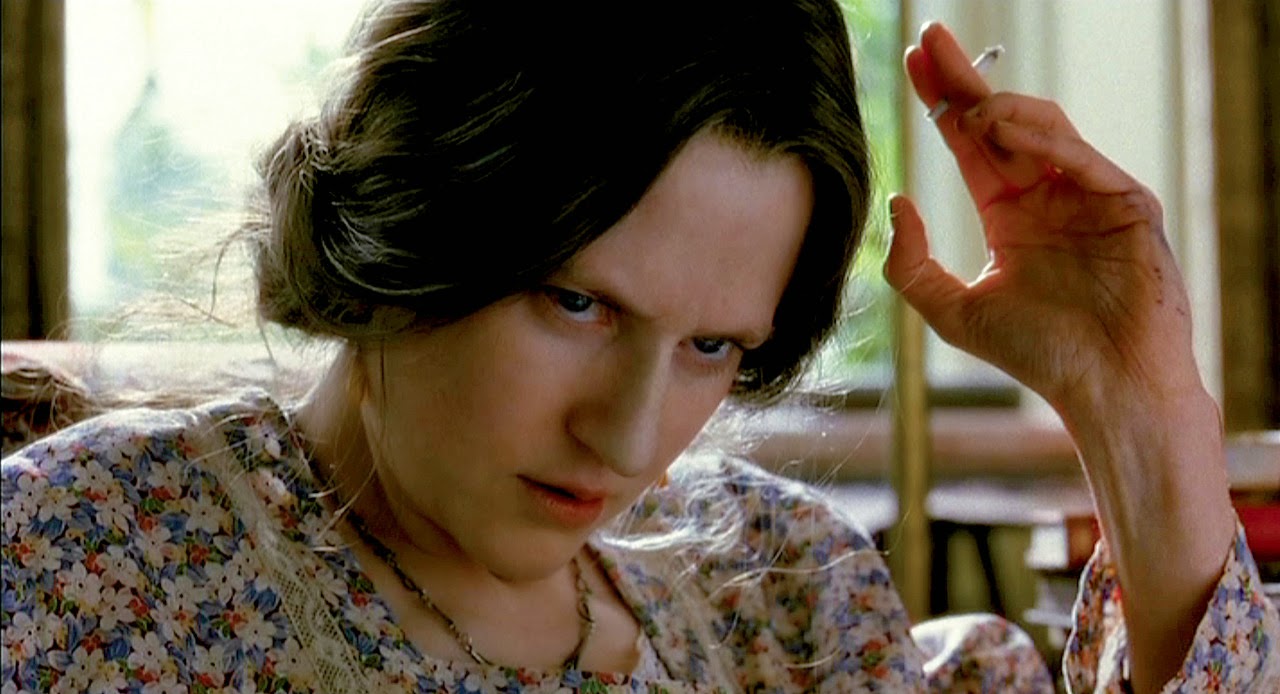
Review - The Hours

The Hours is a fleeting glance into three depressive lives. And yet with such a small scope, the impact is profound.


Life is not what you really are living every "hour". Life is what makes you feel happy, life is what which gives you aim and life is what keeps you motivated. Many people, living their life in those "hours" of charades and trivial errands seek something worth living. Seek a meaning to their life. And when they fail, they their last resort is to break free from this imprisonment. Or, these are the notions what Stephen Daldry's 2002 drama about three morbid women, The Hours, reflects on.

The Hours is an intelligent and highly cohesive drama spanning over decades, showcasing a single day of three different but thematically connected women - In 1920's, writer Virginia Woolf (Nicole Kidman) has began writing his novel "Mrs. Dalloway" while facing severe mental issues. As she writes her novel, we cut to 1950's where a suburban housewife Laura Brown (Julianne Moore), is reading Mrs. Dalloway, as she begins a new day in her mundane life. The film further introduces us to Clarissa Vaughan (Meryl Streep) in 2001 - her life closely resembling the events of novel Mrs. Dalloway. As all three lead characters go through their life on that day, we witness helplessness, yearnings and melancholia.  

Brilliantly performed by pretty much every single actor, The Hours, however, should be remembered Nicole Kidman's heartfelt performance. Even with all those prosthetic bells and whistles, Kidman's performance is natural, real and deeply moving. Julianne Moore and Meryl Streep also are amazing - they remain subtle without going over the top and yet creating a great impact. All performances are wonderfully woven together in a single thread by Philip Glass's ethereal score.
 
The film maybe simply referred as a "suicide" film - the film presents us with three heroines who are struggling to keep themselves intact, almost to a fault, thinking about ending their life at one point in the film. But labeling this film as such would be a crime - it is an intense character study which questions the basic nature of life - Why do we keep on living even we are unhappy and see no hope? As the film progresses to its closure, The Hours provides some great insight on life, hope and realization of our identites.

3.5/5

Thursday, February 5, 2015

Review - Whiplash

Whiplash is a knock down, a sucker punch. Its electrifying. 
You'll want to bang your hand on the wall. 
Not quite my tempo.
I never though instrumental music, or jazz to be precise, will feel like watching a wrestling match. Or a dirty cricket sledging. Whiplash proves that artists are indeed pushed to their extreme limits - by their teachers, peers or themselves, which actually isn't the case. The fact that they won't give up until they prove themselves, over and over again, is indeed what makes them brilliant. Artists are not made overnight.  

Based on director and writer Damien Chazelle's own first hand experience at a music school, Whiplash is about a young jazz drummer Andrew Neyman (Miles Teller) who gets admitted to United States' best music school, Shaffer Conservatory. He is dedicated to his art, focused but still an amateur. He is selected to the school's band by conductor Terrence Fletcher (J.K. Simmons). Fletcher is abusive, verbally and physically to his students. He insults, mocks. He is like Voldemort conducting a jazz orchestra.

What follows after that is a series of some serious action. Not your typical physical action - instead of men, here drums are beaten to death. There are some scenes which show humiliation and bullying in its most worst form. Miles tries, tries harder. His conviction to his art is what keeps him going. Fletcher, on the other hand, knows that Miles is capable of being great. But his way of motivation isn't your usual teacher-student pep talk. Hands bled, drums are broken and thrown over. The film turns into a WWE match (not literally).

Acting here is amazing. First things first, Miles Teller is a great actor. Yes, you can go at lengths that he didn't performed the actual drumming. But his expressions - agony and pain on his face while he's drumming at 200bpm - and yet determined - is a brilliant acting. They say, acting is not just about talking. Miles proves it. J.K. Simmons, however, gets most of the "talk" here and mind you - he is loathsome. His words fire bullets, hitting right on the target. Sometimes, I felt hitting Fletcher with a drumstick right on his bald head. Simmons proves that bad guys indeed make a great impression.

The film is a great example of shooting and editing a music session - the quick cuts, closeups and shots matching the music right on tempo. As if the editor (Tom Cross) himself was part of the orchestra. Visually the film resembles 'The Social Network' - the sepia toned imagery with crisp details. Chazelle is outstanding as a director - his work flows with a thrust, like a hurricane that blows you away. 

The moral issues and ethics are debatable and they should be. How far you should push someone to be great? By the film's end, its stand is pretty much clear. "There are no two words in the English language more harmful than good job", says Fletcher near the end. After watching the masterful 10-minute jazz action at the end of Whiplash, I'd say "good job", Mr. Chazelle.

4/5

Saturday, January 17, 2015

Review - Boyhood

Boyhood is one of those films which showcase life in front of you. Its brilliant.


Richard Linklater is a very different director. His work is, at many times, highly intricate portray of human lives. His work is subtle, often slow but always affecting. So when he makes a film spanning over 12 years and shot over 12 years about a boy growing up - you know it is going to be very personal, special piece of work which will present some great reflections on - well, childhood to boyhood.

So Boyhood is indeed all of this. Even though I am writing this review being an Indian, and Boyhood is quintessential American film, the film is remarkably true to universal nature of growing up. It stars Ellar Coltrane as Mason, initially as a six-year old boy, to all the way upto age 18. The film starts sometime in 2002. Mason lives with her single parent mother Olivia (Patricia Arquette) and elder sister Samantha. Their father Mason Sr. (Ethan Hawke), sees them on weekends and holidays. Over the entire runtime of over 2 and a half hours, the film presents Mason's journey from a fragile 6 year old to a determined 18 year old. And what an amazing journey it is.

The script is wonderfully written - it actually gives all the major event references of respective time frame. Mason is shown playing on a Game Boy Advance early on, going for mid-night release of Half-Blood Prince. As time moves, he and his sister grow - the film references to presidential elections, Iraq War. As the film draws to closure, we even catch references to Lady Gaga, Twilight and Facebook. The character development is so detailed that the film doesn't feels like a "shot and acted" production - its more like peeking through someone's life - his family, his friends. The relationships are so well portrayed that they never feel over-dramatic even for a single instance. It is even more astounding that Linklater had only beginning and ending of the film in mind when he started writing/directing in 2002. He developed the entire script each year, by revising what they have shot previously and taking it forward. And yet, the end-product never feels "stiched together". The narration flows organically without any bumps over its entire duration.

Acting is natural. That is what I can say about the cast of Boyhood. Ellar Coltrane and Patricia Arquette in particular, are so real in their emotions and actions that they elevate the film to what the film has become. Every actor in this film - let it be Patricia's exes, Mason Sr's new wife or her parents, Mason's girlfriend Sheena, Mason's friends or even a plumber guy in a small scene is natural - the film is full of wonderful characters, some of them may remind you of someone from your own life.

It is rather rare to find a film with flesh and blood characters and real narrative these days. What Linklater has achieved - it could be labelled difficult (or easy, given the fact that they had so much time) - is remarkable. Holding on to the faith of completing a film in 12-years alone requires applause. It started as an experiment many years ago and the result of perseverance of a film-maker has resulted in a gem. You may call it slow or even without story - but that's magic of this film- it moves you without story. It may be sequence of events and dynamics of relationships. But that's life. So Boyhood is 12-year snapshot of life. 

4/5

Friday, January 16, 2015

Review - The Imitation Game

This film is not a just a film with great performances - it is the great film overall. Thrilling, suspenseful, entertaining - what else you wish?


The Weinstein Company's this year Oscar juggernaut is surprisingly is not a mere Oscar bait, but it is actually a very good film. The Imitation Game, directed by Morten Tyldum (known for BAFTA-nominated Headhunters) is an entertaining, highly involving film which is supported by all-round great acting and well-balanced script. 

Alan Turing, known for his great contribution to computers and cryptography, played by Benedict Cumberbach. The film primarily focuses on Turing's endeavor to crack Nazi's enigma code. During the World War 2, Nazi Germany was using a highly advanced encryption for their radio messages, generated by a curious electro-mechanical machine, called Enigma. Allies got hold of this machine, but were not able to decrypt any of the signals because the machine had millions of settings and Germans changed their decryption setting everyday. So obviously British military and MI6 required code-breakers and mathematicians for this secret task - to break the enigma. Turing, having a respectable résumé, takes the job, along with his team consisting of a bunch of men and a woman too.

This woman, Joane Clarke, played wonderfully by Keira Knightley, develops an immediate fondness for Turing. Turing is rather an arrogant narcissist on surface. The film accounts this to his tormented childhood - his peculiar interests and school bullying. Turing retreated more and more into this personal shell and became more inaccessible. All of the other colleagues on the mission dislike him but only Joane understood Turing and his emotions. 

Over the less than two hours of the film's runtime, the film provides layered characterization for most of its characters - not only Turing, but also Joane, mission partners Hugh Alexander (Matthew Goode),
John Cairncross (Allen Leech) and MI6 head Stewart Menzies (Mark Strong). The script is very well written - the storyline never becomes stretched or dull in its entire length, which usually is the case with biopics.

Cumberbatch gives an extra-ordinary performance here - it is restrained and never showy. It is always easy to act loud and shout to make an impression, but subtle performances are very hard to pull off. And Cumberbatch did it with a great conviction. His scene with Keira near the end are heartbreaking - "I don't want to be alone." Keira Knightley provides an effective support to Cumberbatch performance, which actually defines the supporting actor role.

Alexandre Desplat's music has worked amazingly well onscreen. His scores always underlines a given scene and are never obtrusive, and yet you always hum his themes when you step outside the theater. He never ceases to amaze me with his work, such a large body of work. The production design is also worth a mention, the WWII era is well depicted along with all the machines and war-era London.

The homosexual element is underplayed, but is not written off. In fact, the injustice done to a brilliant man who helped saving thousand of lives is the integral theme of this film. The Imitation Game is amongst this year's best. Cumberbatch brings his heart and soul to his very fine film.

4/5

Review - Theory of Everything

Eddie Redmayne's masterful performance makes The Theory of Everything worth a watch.

Made for each other...


Documentary filmmaker James Marsh's biopic The Theory of Everything is an elegant, polished production, with heartfelt performances by Eddie Redmayne as theoretical physicist Stephen Hawking and Felicity Jones as his wife, Jane. The film focuses primarily on Hawking's relationship with his wife during his 30-year old marriage. 

The film starts with Hawking's years at Cambridge, where he is enrolled for Ph.D. He is a shy and an introvert fellow but obviously, has brilliant mind. During a party he meets Jane, who is studying arts. Jane is devout Catholic. Hawking is an atheist. She studies poetry and language, he studies black holes. Opposites attract, they say. And so they marry. Meanwhile, Stephen is diagnosed with motor neuron disease, which is destroying his neurons and leaving him paralytic every passing day. He's got only two years, the doctors say.

However, it turns out that doctors are wrong - Jane becomes Stephen's primary caretaker after marriage, while he discovers the vast secrets of the universe. His brain, ever racing, but his body denying everything. Jane stays with Stephen, gives birth to his three children, along taking care of him. But it is not as easy as it seems - the ever increasing responsibilities add extra burden on Jane's shoulders over the years.

The script by Anthony McCarten (also one of the producers), largely focuses on Stephen and Jane, but skims through the marvelous and ingenious work that Stephen has done. While at many times, I strongly felt that the film demanded more of Stephen's work to be presented onscreen, the storyline here is rather dull and formulaic. It proceeds like any other biopic about suffering genius and selfless wife (yes, it does somehow reminds me of A Beautiful Mind.) Also, there is hardly any conflict in relationship so to say. Everyone is nice, decent and composed. No one snaps. It is worth mentioning that the film is a based on a more recent memoir by Jane, which has skipped or positively transformed any arguments or clashes between her husband and herself, which were evident in her earlier memoir post divorce.

But what holds the fort here is outstanding performance by Eddie Redmayne - his physical transformation is worth thousand accolades. What is even more astonishing is that when his character looses his voice after the first half, his face - even with a smallest move - says so much. He not only looked like Stephen Hawking, he talked, walked and expressed like Hawking - or even better then him. That's a wonderful performance. Felicity Jones also leaves an impression, playing the good, helpful wife, but she was towered by Redmayne most of the time. 

Technically the film is extremely well-made, the cinematography is bright and vibrant and has fantasy-like feel to it and like all period films, is too polished. Music by Jóhann Jóhannsson is lovely and touching. It resembles works of Abel Korzeniowski and Shigeru Umebayashi, in a good way ofcourse.

The Theory of Everything is not a brilliant film by any means. It is, however, definitely worth a watch. It does gives some insight, no matter how fleeting, into the genious mind of Stephen Hawking. The marriage and relationship with his wife may feel a bit "made-up" and false, but there is no denying that Hawking could not have achieved great milestones without help and support of Jane. And there is bravo performance by Redmayne, who should win an Academy Award for his outstanding work.

3/5, 0.5 for performances - 3.5/5

Wednesday, January 14, 2015

Review - Birdman, Or The Unexpected Virtue of Ignorance

Birdman's a strange bird of Hollywood in recent times - it successfully blends dark comedy and psychological drama in same film.


Hollywood has some strange obsession with obsessive, twisted and deluded artists. Sunset Boulevard, Opening Night or even recently, Black Swan are some of the examples. Enter Alejandro González Iñárritu's Birdman, whose central character has to prove that he is capable of doing not only pop-corn superhero flicks, but also complex artistic work as well.

Riggan Thomson (Michael Keaton) is an American actor in his early fifties, whose career is pretty much done. He starred in highly successful "Birdman" superhero films, but due to his own personal choice, he refused to do further sequels way back some decades. Now, in hopes of rebuilding his career, he stages an adaptation of Raymond Carver's short story "What we talk about when we talk about love", in which he is all set to play a character and direct as well. Ambious.

Of course it is not as easy as it seems - he has some serious issues with casting. He replaces the male lead, by a narcissist, but outstanding method-actor Mike Shiner (Edward Norton), who makes his life no easy. He has an affair with co-actor Laura and she is pregnant. Her daughter Sam (Emma Stone) has just came back from rehab and Riggan needs to be there for her too. Her ex-wife expects a lot from him. He is facing legal issues with an ex-cast member too. Maybe that was not enough, he is also self-delusional - he thinks that he has telekinetic powers and he can fly. Levitate. Save the world. Birdman's voice is in his head - he says things, a lot of them to Riggin. And yup, there is a snooty critic too, who is going to write a pretty bad review by all means. Reason? She hates Riggin. As the opening night nears, Riggin goes more and more into the psychological turmoil. Will he be able to perform good?

Although all of this may sound hotchpotch, but I don't know how, but Iñárritu along with his three more writers has successfully translated it on screen. And in a single shot no less, more on that a bit later. The film poses some obvious questions about popular culture - the role of critics, success of no-brainer films, social media, artistic merits and so on. Along the way there are some really funny moments - one scene involves Riggin maneuvering through late-evening Times Square in white underwear is a highlight.

Acting is all-around outstanding. Michael Keaton is tailor fit for this role. As many of you may know, he did played Batman in late 1980's, way before Nolan's version came. Funnily enough, Birdman also has Batman-esque voice. Keaton's work here is outstanding - even on stage, where he is supposed to "act" as if he is in a play, his shows wide range of emotions. Norton's performance is equally great - there is a scene involving his character on stage early in the film which is downright hilarious. Emma Stone has never been so good. We also have Naomi Watts here (and a surprise lesbian kissing too, unwarranted). The overall tone of acting by everyone here is a bit hammy, but that's how it is supposed to be.

And now the single-shot thing. The whole film is shot (or lets say edited/computer manipulated) in such a way that the most of its 2-hour duration feels like a single, continuous long shot. Cinematographer here, no guesses required, is the brilliant as ever Emmanuel Lubezki, who won Oscar last year. When you see it, the camera work sucks you right into the film. It is sometimes obtrusive, but it does sets the mood and atmosphere of the theater backstage so well that you feel that you are walking around these characters. Editing also requires a special mention because to seamlessly combine many shots into a single one requires great hard work. Only thing which does not works here is the background score - which does not fits well into the film.

Birdman, however, left me a bit unsatisfied. There is something missing. Maybe its theme, obsession to prove your work, is done may times before. The atmosphere of the film however, leaves a great impact on you. The narrow corridors backstage, the make-up rooms, rooftops and Times Square at night - Birdman is a visual delight. By the very end,  the film has wonders here and there. It is one of the very good films of the year.

4/5

Thursday, December 11, 2014

Review - Gone Girl

Its either a farce, overblown but entertaining cinema. Or a detailed, true portrayal of sad married life. Whatever it is, its something outstanding.

What are you thinking, Amy?.
Amy Dunne has gone missing. Her husband, Nick Dunne is indifferent. He behaves as if he does not cares. He smiles at press conference. He clicks selfies with some random chick. He doesn't knows her wife's friends. He doesn't knows what does she do all day long. He lies. Has Nick Dunne killed his wife?

Director David Fincher is known to cook up some real good suspense thrillers - I daresay, his Se7en is apparently the best suspense-thriller in among recent, post Hitchcock films. On the other hand, we have Gillian Flynn who wrote a great, great novel about messed up married life, all soaked up in twisted murder/abduction plot. When they both collaborate, we have something awesome to behold.

The film's first half presents itself in a series of flashback narrated by Amy - from her diary - how she met her perfect suitor, Nick; how he made her laugh, made her feel important; how they ended up getting married. They lost their jobs. Their "perfect" lives in New York ended up in the quiet town of North Carthage, Missouri. Their small arguments turned their marriage into a hard work. Slowly, slowly, they are hardly talking. Apparently Nick has hit Amy. Amy now fears Nick may kill her.

And this is interwoven brilliantly with Amy's missing case preceding. The both plot threads meet in the middle of the film - the big, big reveal. Till that, you keep guessing. This cross cutting technique (kudos to Kirk Baxter, the editor) works so well, that the entire viewer prospective of characters change. You love Amy at sometime. You love Nick at sometime. You hate Nick. You hate Amy.

The film presents some real shocking observations on the modern American lifestyle, though I'd rather say it has universal appeal. How a serious issue is turned into a media circus. How selfish, money-minded parents may damage a poor child and turn someone into a monster. Marriage is usually hard. Compromised are to be made. Adjustments are must. But usually, these compromises, these adjustments are more or less made by women - the wives. Men also, never get to know women. Husbands don't know what their wives want. Or why women fight over apparently petty issues. What do wives want. What husbands want.
Combined with stress, continuous disregard, loneliness, cheating, plotting - things are always disastrous. Gone Girl presents the viewers with some deep issues regarding marriage, which is something rare because thrillers are usually all fun and no deep themes. But mind you, this is Fincher cinema.

The acting is all round brilliant. Ben Affleck plays Nick Dunne - charismatic, cocky, charming, doubtful and weird. He is a perfect casting. Carrie Coon as soul sister to Nick gave a natural performance. But its Rosamund Pike as Amy who takes the cake. She is smart. Bold. Sexy. Unnerving. Cold. Amazing. What a performance. As if she has over ten characters for each mood. She is outstanding.

Screenplay by Flynn herself is a well balanced version of her wonderfully written novel. The novel is written entirely by two perspectives - Nick's and Amy's for most of the length. Obviously, for the film, it would have not worked. But Flynn morphed her deliciously complex novel into a smart script. Though you will have to miss those wonderful characterizations and descriptions that Flynn wrote.

Fincher gets the job done. He has made another great suspense-thriller with substance. No plot holes. But film is apparently is not believable - I think characters like Amy or her parents perhaps don't exist. Maybe it is a farce. But when you go back, think about it, it is not that unrealistic at all. Either way, farce or truth, Gone Girl is a amazing thriller. Its hard to take your eyes off the screen for most of its run time. Combined with great acting, chilling music (Raznor and Ross -you've done it again), dark, grey frames (Jeff Cronenwerth) - the film leaves you moved, disturbed and highly entertained.

4/5


Wednesday, December 10, 2014

Review: Gosford Park

Robert Altman's Gosford Park is a chatty, uneven slog of a film. This film is a weird mix of British nobility and some typical Agatha Christie novel - when it works it dazzles and when it doesn't its hard to stay awake. And it works so rarely.

A group of British nobles spend their weekend for shooting at Sir Williams (Michael Gambon) and his wife,  Lady Sylvia's (Kristin Scott Thomas) lavish country manor in 1932. Guests include Williams' sister, Constance (Maggie Smith), Sylvia's two sisters along with their husband, actor Ivor Novello along with Hollywood film producer and some others whose name I don't care to write. A murder happens. The host is killed. Who killed poor Sir Williams?

Guests also brought along their one or more valets with them. So in short you have so many characters in the film that you can consider a separate exercise to keep track who's who in the film.  Most of the upper class nobilities have almost similar names. Same is the case of the servants and valets - they are double in number and they are addressed by their master's surname. Confused?

Anyway, the film proceeds in a leisurely manner. Lazy mornings (breakfast on bed), chatty afternoons (or a single case of countryside shooting gig) and spicy evenings (gourmet food and secret sex). For over an hour, we see so many characters speaking of mundane things or things which simply are dispensable in context of the film. These conversations would have mattered if characters had any strong background story - baring a few. Above all, you have to figure out who the hell they are talking about. At least I had to.

But the main plot (which isn't actually the "main" focus unfortunately) - involving Helen Mirren, Clive Owen and Michael Gambon is profound and moving. Also among the herd of actors, Mirren, Maggie and Kelly truly gave an outstanding performance, perhaps their roles were written FOR the film not for filling up the scenes.

Gosford Park is hard to follow - maybe Altman intended it to be like this. I didn't enjoyed it. Maybe its my fault - I should have paid attention. But I wanted to switch off my TV just after 20 minutes. And that isn't good, is it?

2.5/5

Saturday, November 8, 2014

Review - Interstellar (2014)

High on ideas and themes, Interstellar makes your jaw drop - occasionally.


Interstellar, put shortly, is Christopher Nolan's most ambitious film. It tries to handle so many themes in mere three acts - love, survival, wormholes, blackholes, five dimensions and what not. But even with such an weighty baggage the film succeeds putting most of the things just right.

In near future (perhaps about 40-50 years from now), Earth is short of crops. Only corn grows - wheat, okra, etc are all gone. There are frequent dust storms and population is decreasing, apparently due to starvation and lung-diseases. We are introduced to Cooper (McConaughey), a widower former pilot/engineer, who has two children and a father-in-law. Murph (Mackenzie Foy and older version Jessica Chastain), his ten year old daughter, believes that there is a ghost in her room trying to communicate with her. Her father, however, believes that there is no such thing, and there must be some explanation for strange dust patterns on the floor. It leads him to a secret headquarters of NASA, which people believe was shut down many years ago. Professor Brand (Michael Caine) ask him to join the mission to travel a wormhole and discover all the new potential habitats for Humans. Coop agrees, leaving his children behind and aims to save humanity.

Writing beyond this point will probably spoil many crucial events in the film (and honestly, length of this review too). The film's script has enough length so that likes of Anne Hathaway, Matt Damon, Topher Grace and Ellen Burstyn are in the cast. Fortunately enough, barring Damon, everyone does a fantastic job. Matthew McConaughey gives another stellar performance. His relationship with his daughter, Murph is well written and exceptionally executed by McConaughey and Foy/Chastain. Indians are lucky enough to get English subtitled version of Interstellar, without them, the loud sound mix would have muted pretty much every dialogue McConaughey mumbles. Hathaway gives another brilliant performance and her chemistry with McConaughey is great. For the very first time, Nolan has actually given woman in his film a lot more room. Murph and Amelia are Nolan's only female characters which are not just there as dead wives or plot devices. Interstellar is strongly based on elements of parental bonding and love, which are least Nolan like - as if Spielberg's spirit has descended into Nolan.

As expected, cinematography (Hoyte Van Hoytema) in the film is an eye-feast. The color palette used here by Hoytema is consistently bleak. Shot on 70mm photographic film, Interstellar's texture is grainy and sometimes too dark. And yet, its breathtaking. Shots of the space ship passing Saturn in quite space have a dream-like quality.

For the first time, wormholes and blackholes are shown in a film like they would actually appear (if they exist!) based on mathematical models. One set piece, which showcases a giant tidal wave will certainly take you to the edge of your seat. There is another one, which involves a rotating space station, which looks more redundant than impressive, thanks to 2013's amazing Gravity. Hans Zimmer's music is finally not recycled from his own previous scores, which is a welcome change. Score is obtrusively loud sometimes, but the main theme of the film, which is just some few notes on a church organ, is beautiful.

*inevitable major spoiler ahead*
For those who are concerned about the film's physics I can safely assure that it is no harder than Wikipedia's introductory passage on Time Dilation, Black Holes or Wormholes. Kip Thorne has given some input to the film, but I reckon it extends beyond visuals.  In the third and final act, Cooper literally and delibrately falls into a black hole to unriddle the mystery of singularity. Cooper does survives, defying pretty much everything which physics tells us - about heat, Roche limit and event horizons. What follows after that is apparently what you have seen many times before - in Back to the Future or even Harry Potter and the Prisoner of Azkaban, but in five dimensions. The film goes from interstellar travel to time travel within matter of minutes.

If you think back after the end of the film, you notice many paradoxes and plot holes of size of a black hole. But if you cling to suspension of disbelief, Interstellar all-together ends with a sublime and haunting note. Nolan may not have excelled in general relativity but in film-making, he's no less than Einstein. It is not a perfect film by any means, but alas, it would have been a masterpiece if it had got everything right.

4/5

Monday, September 15, 2014

Review - Maleficent

Angelina Jolie is the life and soul of this film. 
Beautifully wicked...
In 1959, Disney released 'The Sleeping Beauty' - an animated film which was considered to be Disney's most expensive production ever. However, it failed to earn over-whelming response from critics' or the audience. Years later, Disney has once again retold the classic fairy-tale - 'Maleficent' is not exactly a live-action remake, but a re-imagination of the beloved Brothers Grimm story. Told from the perspective of the evil nemesis herself, Maleficent is a more complex version, with a back-story and alternate ending. The character itself is a given complete make-over, so if you are a fan of pure evil, you are going to be disappointed.

Instead of directly starting with the Christening gathering of King Henry's charming daughter Aurora, the film provides a lengthy background story of Maleficent. Maleficent is shown as a young, naive fairy, who was once betrayed by Henry for the greed of throne. Driven in revenge, she curses the baby girl.  The film mostly follows 'The Sleeping Beauty', but instead of Maleficent plotting against Aurora, the film portrays her as more benevolent character. Linda Woolverton, the screenwriter, hits the bulls eye for the characterization of Maleficent. The character is much more layered, with qualities of forgiveness and kindness along with anger and revenge. Compared to The Sleeping Beauty's nemesis, this Maleficent is certainly a more interesting character in itself.

And Jolie does a remarkable portrayal of such an amazing character. In one of these early scenes, Jolie howls and cries in agony - like a wounded beast - and yet maintaining humanly affliction. In the highlight
curse scene, Jolie is pure evil. Her words resonate the entire hall with great power, with a bad-ass style. There are so many bits of great acting scattered here, and there, that you certainly understand why Jolie remains one of the best Hollywood super-stars.

Unfortunately, the script is so engaged with the Jolie that all of the other characters are side-lined - expect for King Henry - whose characterization has a some depth. Aurora (played by Elle Fanning) is once again your typical Disney fairytale princess which looks good, does good, and is mostly in awe. The three pixies who raise Aurora far from the Kingdom are caricatures. Quite surprisingly, they are played by Imelda Stauton, Lesley Manville and Juno Temple - great actors - but are given a substandard script.  The plot somewhat drags in the middle - which could be attributed to repetitive scenes of young Aurora.

Robert Stromberg, a gifted artist whose credits include 'The Aviator', 'Pan's Labyrinth', 'Avatar', 'Alice in the Wonderland', and so on; tried his hands on direction for the first time. He has an eye for visuals - there is no doubt in it, his two Oscars are mere proof of this statement. For a debutant director, Stromberg certainly exceeds expectations. His imagination of the entire fairytale land is dazzling, the set design for this film is one of the year's best. Unlike 'Alice in the Wonderland (2010)' where he bombarded the sets with overly colorful and flashy art designs, Maleficent's art direction is a lot more subtle, something which should also be credited to the production designers. Stromberg is also great at drama and emotions, churning out the best in Jolie. The action sequences are where he faltered; they are poorly staged and merely for the sake of it.

In the end, Maleficent is all about Jolie and the wonderful visuals. Apart for Maleficent's character herself, the film lacks any rich portrayal of any other character. Also, purists will certainly feel that the film has altered too much of the original story. That said, the film is a satisfying experience and should be considered one of the Jolie's best work.

3.5/5

Friday, September 12, 2014

Review - The Amazing Spider-Man (2012)

The Amazing Spider-Man is a futile exercise in film-making and is nothing new. But it is good enough for further installments.

The love birds... oh sorry, one is a Human-cum-Spider.
It all started when production of fourth installment of Sam Raimi's Spider-Man films when sour, due to "creative difference" between Sony and Raimi. When Raimi backed out, Tobey and Dunst backed out as well. Sony's multi-million dollar franchise's future was unclear.  The solution to this was rather simple - a clean reboot of the film series. Just like you reboot your computer when it is not responding.

But that's really unfortunate that film series' reboot is not as simple as your computer. The third Spider-Man film by Raimi was met with luke-warm reception with critics and audience alike; it grossed pretty below expectations. Was rebooting the entire franchise in such a short time interval (about 5 years) a good move?

While I will keep my final judgement regarding this to myself until I see the sequel to this film, but it is fairly safe to assume that future of Marc Webb's version is safe. The film follows the original Spider-Man (2002) very closely, although there are some good and bad changes here and there. For example, uncle Ben's death here is presented a lot more clearly; while Peter's evolution as Spider-Man is rather sketchy and rushed. Also, setting the story in high-school is a welcome change.

Our friendly neighbourhood is now played by Andrew Garfield who plays Spider-Man in a lot more pausible
attitude as compared to Tobey, and his looks suit the whole high-school set up. Tobey, on the other hand had some better skills at comic timing and on-screen charm, which Garfield certainly lacks. Garfield's Peter is a cry-baby, tearing up quite often. Love interest here is Gwen Stacy rather than Mary Jane Watson. Emma Stone is really good as Gwen, certainly more suited companion to Peter than Mary (played by Kirsten in previous films in a rather dull way). Other returning characters include Uncle Ben (Martin Sheen) and Aunt May (Sally Field, for a paycheck certainly). Norman Osborn and Harry Osbron are not in the film, although majority of the film's action takes place at the Oscorp.

First half of the film is exactly more or less same as the first Spider-Man. The new villian introduced to us is Rhys Ifans as Dr. Connor/Lizard (finally he is a biologist rather than a physicist). His transformation as the Lizard is so badly written that I would rather not comment on it. And yes, our Irrfan Khan is also present for two-three scenes with some dailogue. His work in Life of Pi, released in same year, adds more to his resume than this. The built up to the climax is hurried and under-developed. The entire ending is also your typical super-hero ending, with no new element.

Marc Webb's vision is stylish and technically sound as it should be, but it lacks straight-forwardness and cinematic grandeur that Sam Raimi brought to the screen. The film is shot in Red EPIC in 3D, and the night scenes certainly look too pristine and brightly lit to be real. The trademark spider-cam shots are present too, with new POV shots, which look really good. Editing is really bad, many scenes feel rushed and abrupt. Visual Effects are passable, the Lizard doesn't look intimidating at all; something which should be attributed to the failure of the production design team.

So should you keep your faith in this new Spider-Man? Certainly yes; mainly because of the two leads - Garfield and Stone. They make a really good pair, play their parts with conviction. Without them, this Amazing Spider-Man has nothing "amazing" to offer.

2.5/5

Sunday, September 7, 2014

Review - Her

Her is a prime example of a short-film concept stretched like rubber for a full length film

Its time to sleep!

I haven't seen much of Spike Jonze's directorial features (to name one, Adaptation, which bored me to sleep). His scripts are mostly written by Charlie Kaufman, but this time he helmed the writer seat for his next venture - a futuristic science fiction comedy drama about a man who falls in love with his Operating System (or iPhone's 100x improved Siri, whatever). And the prime reason for this romance between a human and machine is voice of Scarlett Johansson. Boy, her voice is sexy.


Our protagonist is Theodore (Joaquin Phoenix), who is an introvert, loner and a complete bore. He works in a firm whose employees write hertfelt letters for people who do not  have time to write. He writes really good, as we are told. But good love-letter writing doesn't means a good marital life, so he is about to get divorced from his childhood sweetheart Cathrine (Rooney Mara). He is sad. He is melancholic. He barely speaks up his mind. He plays a video-game with an abusive little character. He engages in phone sex. In short, he is prime candidate to fall in love with the next living thing(or non-living, in this case).

Enter Samantha, sexy, smart, funny computer OS with Scarlett's voice. Theodore is delighted. She arranges his work, his meetings (I don't think he had many though) and she reads her emails (professional and private ones). Samantha is non-judgemental, considerate and highly respecting towards Theodore. They fall in love.

But as soon as they start dating (and voice-sexing, if there is any thing like it), things start to really drag. The film with all soft tones and moody atmospheric score, at first is captivating, but for 2 hours, it is major ingredient for sleep. On a conceptual level, its all intriguing, but come on, it is weird. You really cannot make a human being, no matter how introverted or shut out, fall in love with a voice. Without a face. Without a body.

Joaquin Phoenix's Theodore has limited range of expressions - sad, more sad, smiling but yet sad -  which may put Edward (of Twilight) to shame. Of course, it was the script's requirement. Amy Adams is sleepwalking in this sleep inducing film. Rooney Mara appears and disappear, like a ghost. Only Scarlett's Samantha is an 'alive' thing, which is ironic since she is an OS.

Spike Jonze's Her might have won hearts all over the world. But I don't think I am ready to acknowledge the whole 'human-computer' love thing. Its illogical. But films are not always about logic, so Her may just pass as a failed experiment for me.

2/5
 

Friday, February 28, 2014

Review - Captain Phillips

'Captain Phillips' sails on turbulent waters

Paul Greengrass's 'Captain Phillips', based on real events that took in 2009 in Indian ocean, is an edge-of-seat thriller, however, emotionally distant, even though the film showcases some flawless acting by Tom Hanks near the last 10 minutes. This docudrama keeps the viewer restless and tense throughout its first half, but it does looses the steam later on. By the end of its super tense climax which reminded me of Argo (in a good way), I felt a little exhausted, a little lost and a little disappointed.

Captain Rich Phillips is a US mariner, whose most recent task is the shipment of support material like food and medicines to Mombasa, Kenya. On voyage, the ship is hijacked by four Somali pirates (their leader is Abduwali Muse, played by Barkhad Abdi). The first attempt for hijack fails, but on the second attempt, the pirates succeed. The captain and the crew, despite their best efforts, loose the control of the ship. Things turn ugly when the captain himself is kept hostage on the life-boat for 5 days. Muse demands 10 million dollars, Captain ain't got it. Mayday. Enter US navy seals and other American maritime forces to save Captain Phillips. And no, I won't spoil it further.

But what follows are some exciting, gripping moments, which showcases some immense talents of wide range - direction, editing, sound design, visual effects and acting. Tom Hanks' performance rises like a steep mountain - he is apt in the beginning, very good in the middle and exceptional in the last minutes. His transformation as a character from an emotionally strong, rigid man to a wounded, shocked soul is a marvelous. He has lost an Oscar nomination though, but its no denying, Hanks is at top of his game in this film.

Barkhad Abdi walks like a pirate, talks like a pirate and yes, looks like one too. It is a great casting choice, and Abdi complemented Hanks very well. 'No problem "Irish", everything gonna be OK. Nobody's gonna be hurt", Abdi says it with a great competence.

Greengrass, without any second thoughts, was perhaps the best suited director for this film. He has proved that he is the master of fast paced action thrillers (see Bourne series).  In this one, however, he somehow gets lost in action and the emotions. Film's tone shifts from emotional one to an action one a lot, specially in the end. It may have worked, but for me it didn't. Also, Bill Ray (screenwriter) at the same time wants us to sympathize with the pirates but also wants us to feel proud and all happy when three of them are shot (one of them is adolescent). Its all thematic hotch potch. But yes, you can't portray your own country in a grey shade, can you?


'Captain Phillips', at the very end, is a very well made film with some great talents all around. You should give it a chance, definitely. You may love it, or maybe not so much, like in my case.

3.5/5

Saturday, February 8, 2014

Review - The Game

Even with a foolish twist, The Game an engaging, edge of seat thriller which keep you guessing.
  Spoilers ahead -
 Its 1997, and its David Fincher's second consecutive attempt at Thriller genre - his first attempt - as you all know, is a mind-blowing nerve wrecking Se7en. He got the bulls eye at that time. Does his next project, The Game, with a very intriguing premise holds up the fort?

Well, then my dear friends, The Game is what Se7en was not - it is fast-paced, full of action, stylish and unfortunately absurd. We have our protagonist,  Nicholas Van Orton is a rehashed version of Gordon Gekko - snobbish, emotionally distant and  introvert. Apparently his shoes costs around a thousand dollars. Nicholas is a private banker, had a divorced from his wife (though they remain friendly) and has a estranged brother Conrad (Sean Penn, wasted). Nicholas had a troubled childhood, he apparently saw his father committing suicide by falling from a top of a building, at his 48th Birthday no less. So when his own 48th birthday arrives, his brother Conrad shows up out of the blue, gives him a voucher for a "game" - developed by a company called CRS (Consumer Recreation Services). Without giving him any details how exactly the "game" works, Conrad tantalizes Nicholas by promising it will change his life.

Intrigued by the Game, he reaches CRS, spends all his day for the test they require for him to participate which includes handwriting samples, Q&As and physicals. But he is rejected, told on the phone. After that, he learns that the game has just begun - it is no recreation but an assault to his privacy (a scene involving a dummy clown and TV is a highlight of the film), his wealth and his life. Through series of events he escapes from the clutches of CRS employees, often with the help of beautiful mystery girl played by Deborah Kara Unger. In all bizzare turn of events, he finds himself somewhere in Mexico, snatched of all his money, his accounts are drained. Near the end, he sets out for revenge near the end and sets his aim to unmask the man behind this.

Until now, you have already guessed that it makes no point having a star like Sean Penn in the film for just 2 scenes. So yes, he is behind this dreadful game. And guess what, is he up for his brother's money? Tada! Wrong answer - he just played out all this as a prank, so that his brother can face the reallity and enjoy his life. What!

The climatic twist at the end is as absurd as absurdity goes. It matches 'The Village' for the most impossible plot. I wonder what Fincher was thinking when he made it. Or what the screenwriters thought when they wrote it.

But still, there are very few movies in which even the so-called twist is hard to digest, engulfs you and captivates you into its atmosphere. David Fincher is a master when it comes to creating atmosphere on silver screen. The mood, the thrills and the creeps you get, is all worth your time even with an illogical finale. Aptly shot by Harris Savides, The Game hardly has any dull moments. It is an engaging, edge of seat thriller which keep you guessing. Remove that last 5 minutes from it, you've got pure Fincher cinema.

3.5/5